
Most small business owners never think about how a lawsuit would actually reach them until the day a stranger asks for them by name at the front desk, or worse, until they learn a court ruled against them in a case they never knew existed. Legal papers follow formal rules, and those rules are built around the addresses you listed when you formed your company. If those addresses are out of date, unstaffed or hard to reach, you can lose a case simply by not showing up.
This guide explains what service of process is, how it works for a small business, why your registered agent matters so much, and how to build a simple routine so that legal mail and court papers never sit unopened. It also covers the difference between legal papers and ordinary official mail, which often gets confused.
What service of process means
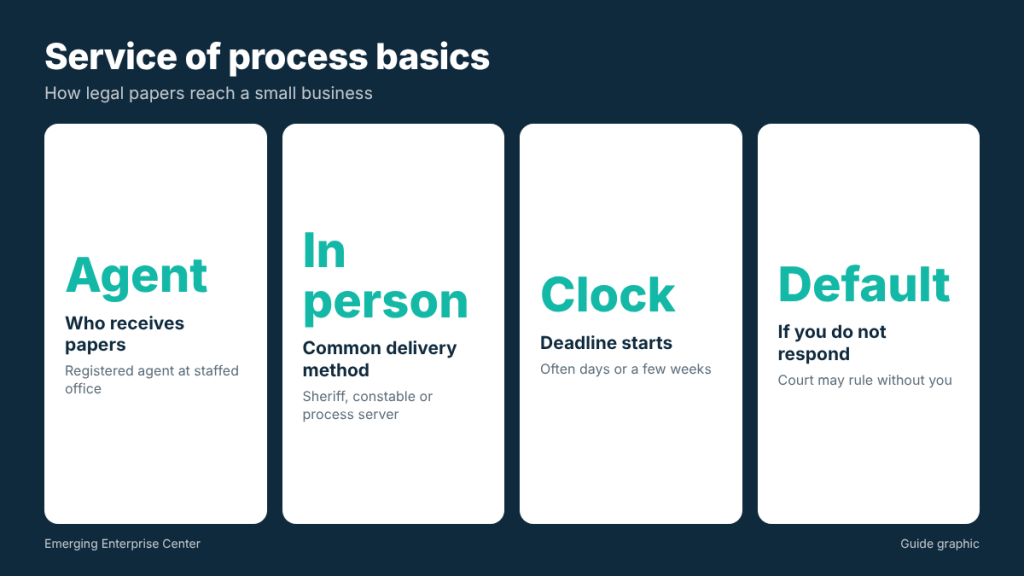
Service of process is the formal delivery of legal documents that tells a person or business they are being sued or are part of a legal proceeding. The core document is usually a citation or summons along with the petition or complaint, which describes what the other side claims. Other documents, such as subpoenas, can also be served.
The point of service is fairness. A court cannot move forward against you until you have been properly notified and given a chance to respond. Once you are served, a clock starts. Response deadlines in civil cases are often short, measured in days or a few weeks rather than months, and the exact deadline depends on the court and the type of case.
If a business does not respond in time, the other side can ask the court for a default judgment. That means the court may decide the case without hearing your side, and a default judgment can lead to bank levies, liens or collection actions.
Who receives legal papers for your company
For an LLC or corporation, the person designated to accept service is the registered agent. When you file a Texas certificate of formation, you name a registered agent and a registered office. A registered agent must have a physical address staffed during business hours, which is why a mailbox, by itself, does not meet the requirement.
Your registered agent can be:
- You or another owner, if you have a Texas street address where you are reliably available during business hours.
- An employee or trusted person with consent to serve in the role.
- A commercial registered agent service that accepts papers at a staffed office and notifies you, usually by email and scan.
Texas requires that the agent consent to the appointment. If you list someone, make sure they actually agreed and understand what to do when papers arrive.
What happens if your agent cannot be found
Texas law provides fallback options when a registered agent cannot be located with reasonable effort, including service through the Texas Secretary of State in certain situations. The papers are then forwarded to the address the state has on file for your company. If that address is old, the papers can go nowhere useful. This is the scenario where businesses most often learn about a lawsuit too late.
How papers are usually delivered
The method depends on the court and the rules that apply, but the common routes include:
- Personal delivery by a sheriff, constable or private process server, handed to the registered agent or another authorized person.
- Mail methods that some courts allow, often requiring a signed receipt.
- Alternative service ordered by a judge when normal methods fail, which can include leaving papers at a location or other approved methods.
Because personal delivery is common, the registered office must be a place where a real person can accept documents. A process server who finds a locked door, an empty home or an address that only forwards mail will document the failed attempts, and that record can support alternative methods that make it even easier to miss the case.
Legal papers vs official mail: know the difference
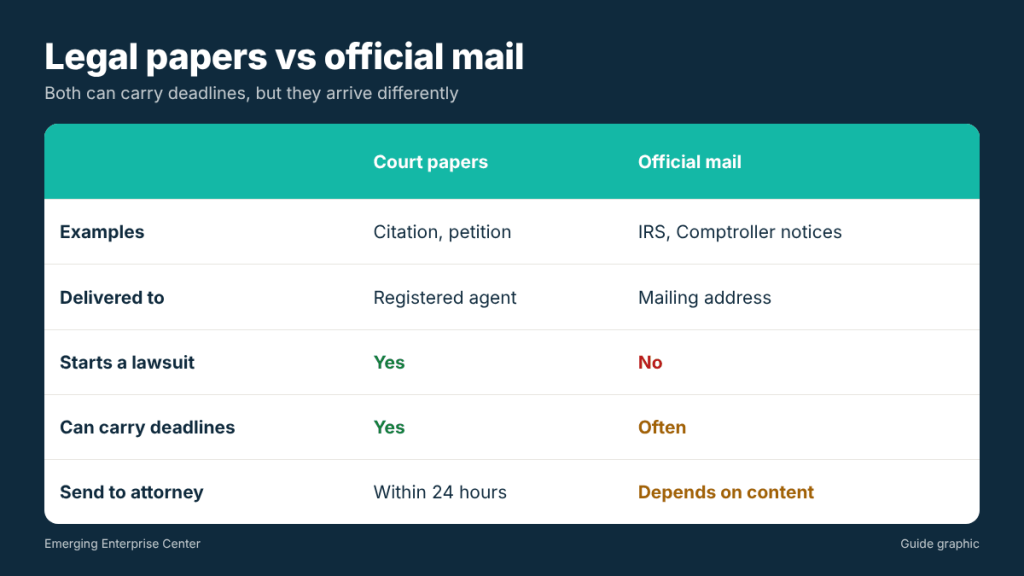
Not every serious-looking envelope is service of process. Your business will also receive a steady stream of official mail that does not start a lawsuit but still deserves attention:
- IRS notices and letters about filings or balances
- Texas Comptroller correspondence about franchise tax or sales tax
- Secretary of State notices about your entity’s status
- Demand letters from attorneys before a suit is filed
- Certified letters from landlords, lenders or vendors
These items go to your mailing address, not necessarily your registered agent. That is why you need a dependable mailing address as well as a dependable agent. Both channels can carry deadlines.
On the other side, many businesses also receive mail designed to look official but that is really a solicitation. Learning to tell them apart prevents both panic and complacency. When in doubt, verify the sender by looking up the agency’s contact information yourself rather than using a number printed on the letter.
A simple legal mail routine for small businesses
You do not need a legal department. You need a few habits that make sure nothing slips:
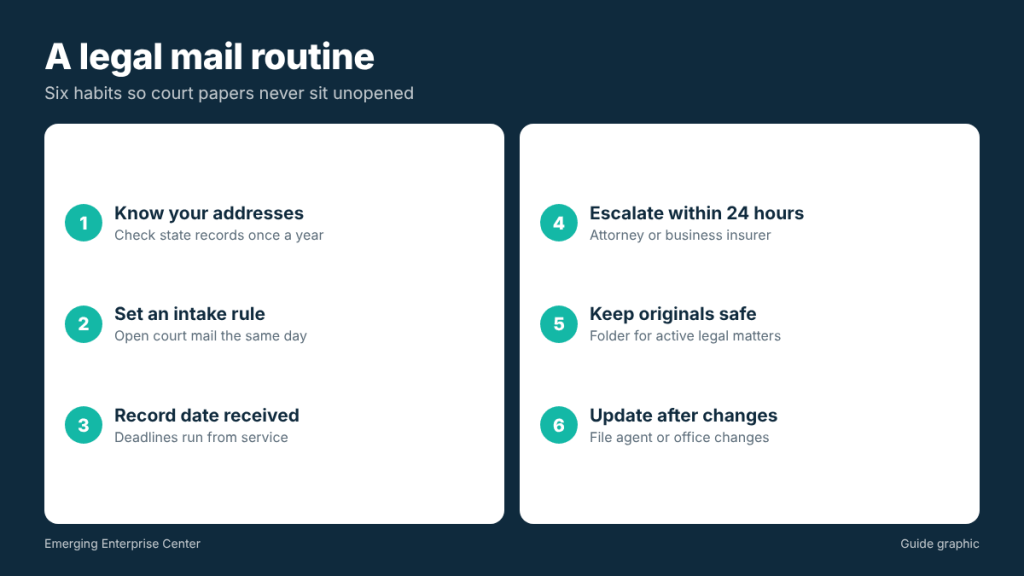
- Know your addresses. Write down your registered agent, registered office and mailing address, and check them against the state’s records once a year.
- Set an intake rule. Anything that mentions a court, a case number, a citation or a deadline gets opened the same day and scanned to the owner or manager.
- Record the date received. Write the date and how it arrived on the first page or in a log. Deadlines usually run from the date of service, so this detail matters to your lawyer.
- Escalate within 24 hours. Send court papers to your attorney or business insurer quickly. Some insurance policies require prompt notice of claims.
- Keep the originals safe. Store the physical papers in a folder for active legal matters. Do not write on them beyond the date note.
- Update after every change. When you move, change agents or close a location, file the update with the state promptly.
Worked example: missed papers after a move
Consider a small LLC that listed the owner as registered agent at her old home address. She moved, set up mail forwarding and forgot to update the state filing. A vendor sued over an invoice dispute. The process server made several attempts at the old home, where the new owners had no idea who she was. The court allowed alternative service, and a default judgment followed. She learned about it when her business bank account was frozen.
Two small steps would have prevented this: naming a staffed registered agent, and updating the registered office when she moved. Mail forwarding alone does not redirect a process server.
Choosing a registered agent setup that fits
Ask yourself these questions:
- Are you at a fixed Texas address every business day? If not, being your own agent is risky.
- Do you want your home address on public record? The registered office appears in state records. A commercial agent keeps your home off that record.
- How will you be notified? A good agent service tells you the same day and sends a scan.
- Who opens your regular mail? A private or digital mailbox with scanning helps you catch official notices quickly when you are away.
Many owners combine a commercial registered agent with a private mailbox for everyday mail and packages. Each address does its job, and neither depends on you being home.
Frequently asked questions
Can I use my private mailbox as my registered agent address?
No. A registered agent must have a physical address staffed during business hours where papers can be handed over. A mailbox can be your mailing address, not your registered office.
Can someone serve me at home instead of my business?
Depending on the case and the rules that apply, an individual owner may be served personally. For the company itself, service is normally directed to the registered agent.
What should I do the day I am served?
Write down the date and time, keep all papers together, and contact an attorney or your insurer promptly. Do not ignore it, even if you think the claim has no merit.
How do I check my registered agent on file?
Look up your entity in the Texas Secretary of State’s business records or contact the office directly. Update the information with the appropriate filing if it is out of date.
This article is general information, not legal advice. Court rules and deadlines vary, so consult a licensed attorney about any specific legal matter.
Want a reliable place for everyday business mail?
Pair your registered agent with a private mailbox in Houston that receives mail and packages from every carrier, so official notices land somewhere secure even when you are out.