An Employer Identification Number, or EIN, is the federal tax ID for your business. Banks ask for it before opening a business account, payment platforms want it for tax reporting, and you need it to hire employees. Getting one is free and often takes less time than finding a parking spot, yet new owners still make avoidable mistakes: applying before their LLC exists, paying a third-party site for something the IRS gives away, or listing an address they never check.
This guide explains who needs an EIN, the order of steps that avoids problems, how to answer the trickier application questions, which address to use, and what to do after you have your number. It is written for new owners forming an LLC or corporation, with notes for sole proprietors.
Who needs an EIN
The IRS uses EINs to identify business entities. As a general guide, you will usually need one if your business:
- Is a corporation or a multi-member LLC (taxed as a partnership or corporation)
- Has employees, or plans to hire soon
- Files certain federal tax returns, such as employment or excise tax returns
- Is a single-member LLC that has employees or needs one for certain tax filings
- Needs one because a bank, lender or platform requires it
A sole proprietor with no employees can often use their Social Security number for business purposes. Many still get an EIN anyway, so they can give clients and vendors a business number on W-9 forms instead of their personal SSN. That is a simple privacy win.
Single-member LLCs are a common gray area. Even when the IRS does not strictly require an EIN for income tax purposes, most banks will ask for one before opening a business account. Check the IRS guidance for your situation and plan on getting one.
The right order of steps
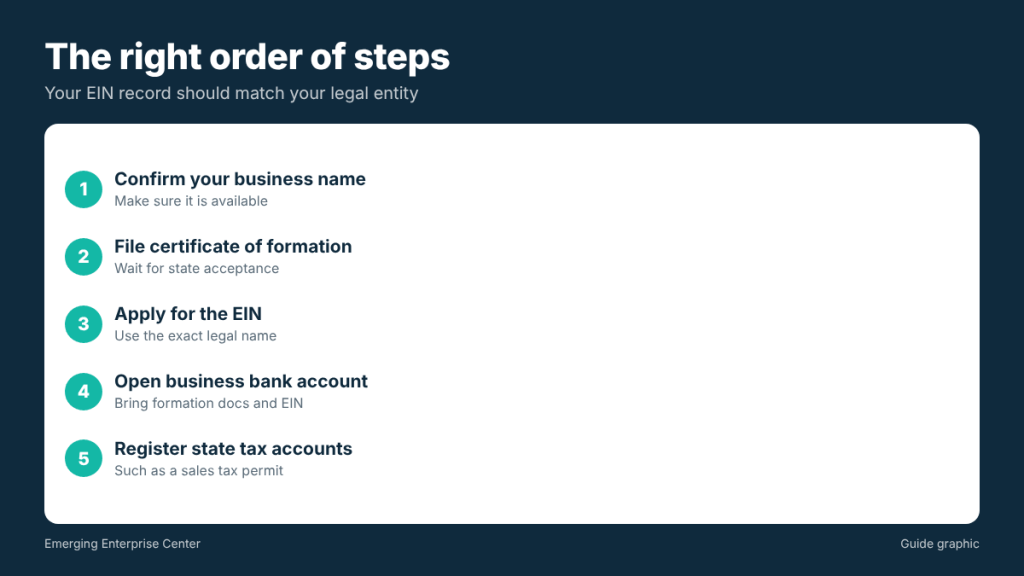
Timing matters because your EIN record should match your legal entity exactly. For a Texas LLC or corporation, follow this order:
- Choose and confirm your business name so you know it is available.
- File your certificate of formation with the Texas Secretary of State and wait for it to be accepted.
- Apply for the EIN using the exact legal name from your approved filing, including “LLC” or “Inc.”
- Open your business bank account with your formation documents and EIN.
- Register for state tax accounts as needed, such as a sales tax permit with the Texas Comptroller.
Applying for an EIN before the entity exists, or with a slightly different name, can create mismatches that slow down bank accounts and tax filings later.
How to apply
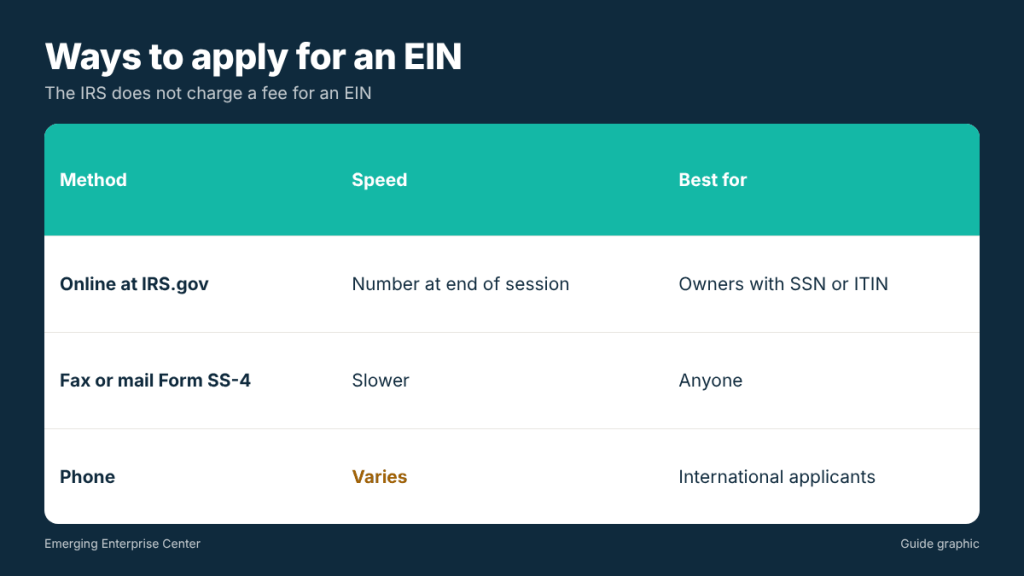
The IRS offers several ways to apply, and it does not charge a fee for an EIN:
- Online through IRS.gov. The fastest option for most US-based owners. You receive the number at the end of the session. The online application requires the responsible party to have a valid SSN or ITIN.
- By fax or mail, using Form SS-4. Slower, but available to anyone.
- By phone for international applicants, who may have no US taxpayer number. Check the IRS website for current instructions.
Be careful with search results. Some websites look official but charge to submit the same free application. If a site asks for payment to get an EIN, you are not on the IRS website.
Questions on the application that confuse people
Responsible party
The responsible party is the individual who ultimately owns or controls the entity. For most small businesses, that is the owner or a managing member. It must be a person, not another company, in most cases.
Type of entity
Choose the option that matches your legal structure and how you are taxed. A single-member LLC is typically treated as a disregarded entity by default, and a multi-member LLC as a partnership, unless you elect otherwise. If you plan to elect S corporation or C corporation tax treatment, talk to a tax professional about timing.
Reason for applying
For a new business, this is usually “started a new business.” Other options cover hiring employees, banking purposes and changes in organization type.
Date business started and accounting year
Use the actual start date, often the date your formation was effective. Most small businesses use a calendar year ending in December.
Which address to put on your EIN application
Form SS-4 asks for a mailing address and, if different, the street address of the business. The IRS will send notices, letters and your confirmation notice to the mailing address, so choose carefully:
- Pick an address you check reliably. IRS letters can carry response deadlines.
- Think about privacy. If you do not want your home address on business correspondence, use a business mailing address such as a private mailbox.
- Answer the street address question accurately. If the form asks where the business is physically located, give your actual operating location.
- Stay consistent. Use the same mailing address format for the IRS, your bank and your state accounts.
If your address or responsible party changes later, the IRS uses Form 8822-B to update that information. Check the form’s instructions for when you need to file it.
After you get your EIN
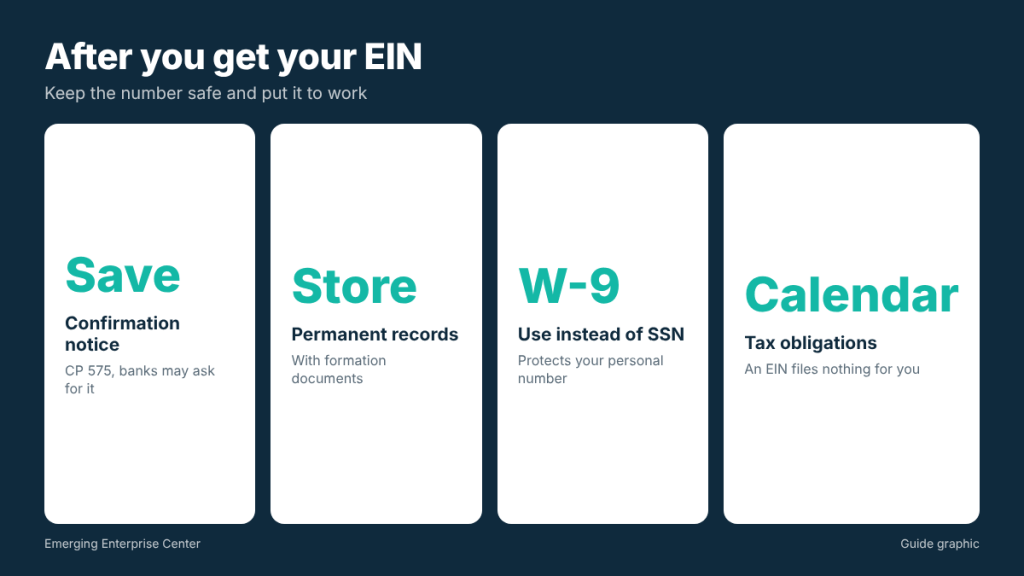
- Save the confirmation. Download or print the confirmation notice the IRS provides (commonly known as the CP 575). Banks sometimes ask to see it.
- Store it with your permanent records, alongside your certificate of formation and operating agreement.
- Use it on W-9 forms instead of your SSN when clients request your tax information.
- Open your business bank account and keep business money separate from day one.
- Calendar your tax obligations. An EIN does not file anything for you. Ask your tax professional what returns and deadlines apply.
Worked example: a new single-member LLC
James forms a Texas LLC for his remodeling consulting work. His certificate of formation is accepted on a Monday. That afternoon he applies online, listing himself as responsible party, choosing LLC with one member, and using his private mailbox as the mailing address and his home as the street address where the work is managed. He saves the confirmation PDF, opens a business checking account on Wednesday with his formation documents and EIN, and gives clients a W-9 with the EIN instead of his SSN. Total time spent on the EIN: under an hour.
Where your EIN will be used next
Expect to give your EIN to more places than you think. Keep it handy, but share it only through secure channels:
- Your business bank, credit card issuer and any lender
- Payment processors and online marketplaces for tax reporting
- State agencies, such as the Texas Comptroller for sales tax or franchise tax accounts
- Clients who need a W-9 before paying you
- Your payroll provider, once you hire employees
- Business insurance applications and some vendor credit applications
Common EIN mistakes to avoid
- Applying under your personal name instead of the LLC’s legal name
- Getting a second EIN by accident because you lost the first one (ask the IRS for help locating it instead)
- Paying an unofficial website for a free service
- Listing an old or rarely checked mailing address
- Assuming you can keep a sole proprietor EIN after forming an LLC or corporation; a change in structure often requires a new number
Frequently asked questions
How much does an EIN cost?
Nothing. The IRS issues EINs for free. Paid services only submit the same application for you.
Can I use a private mailbox address on my EIN application?
You can generally use it as the mailing address. Answer any physical location question with where the business actually operates.
Do I need a new EIN if I move?
No. Moving does not change your EIN. Update your address with the IRS using the appropriate form.
I lost my EIN. What now?
Check your confirmation notice, old tax returns or bank records. If you still cannot find it, the IRS can help you look it up rather than issuing a new one.
This article is general information, not tax or legal advice. Confirm your situation with the IRS or a qualified tax professional.
Want IRS mail to go somewhere other than your home?
A private mailbox with a real street address in Houston gives your new business a reliable mailing address for IRS notices, bank mail and packages.