Almost every new owner starts the same way: a few business purchases on the personal card, a client payment deposited into the household checking account, a receipt tucked in a wallet. It feels harmless when the business is small. A year later it means hours of untangling statements at tax time, deductions you cannot prove, and, for LLCs and corporations, a weaker argument that the business is truly separate from you.
This guide gives you a practical system to separate business and personal finances from day one: the accounts to open, how to pay yourself, how to handle expenses that are partly personal, how to manage receipts and statements, and a monthly routine that keeps everything clean. It also covers what to do with old financial paper once you no longer need it.

Why separation matters
- Liability protection. If you formed an LLC or corporation, keeping its money separate supports the idea that it is a distinct entity. Commingling funds is one of the factors that can weaken that protection.
- Cleaner taxes. When every business transaction lives in business accounts, your bookkeeper or tax preparer can work from statements instead of reconstructing a year from memory.
- Provable deductions. Clear records make it far easier to support business expenses if you are ever asked about them.
- Better decisions. You can only see whether the business is profitable if its money is not mixed with groceries and rent.
- Credibility. Lenders, investors and buyers expect clean books.
Step 1: open the right accounts
The foundation is simple: every business dollar in and out should move through business accounts.
- Business checking account in the business’s legal name, using your EIN and formation documents. All client payments land here.
- Business savings account for tax set-asides and a cash reserve.
- Business credit or debit card used only for business purchases.
- Payment processor accounts (card payments, invoicing tools, marketplaces) connected only to the business checking account.
Banks generally ask for formation documents, your EIN and identification, and they want a business address. Using a dedicated business mailing address keeps statements, cards and notices separate from personal mail as well.
Step 2: decide how you will pay yourself
Moving money from the business to yourself should be a deliberate, recorded transfer, not a swipe of the business card at the grocery store.
- Single-member LLCs and sole proprietors usually take an owner’s draw: a transfer from business checking to personal checking, recorded as a draw.
- Multi-member LLCs take draws or distributions according to the company agreement.
- Corporations and S corporations often pay owners through payroll, with distributions on top. Ask your tax professional how this applies to you.
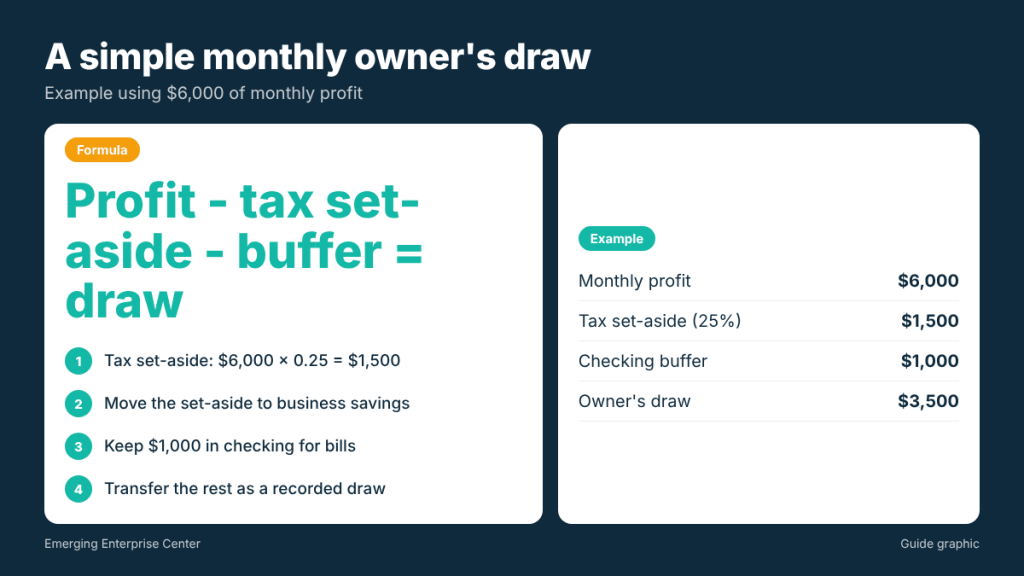
Worked example: a simple monthly draw
Suppose your business earned $6,000 in profit this month after expenses. You decide, with your accountant, to set aside 25 percent for taxes. That is $1,500 ($6,000 times 0.25) moved to business savings. You also keep a $1,000 buffer in checking for next month’s bills. That leaves $3,500 ($6,000 minus $1,500 minus $1,000) available to transfer to yourself as a recorded draw. One transfer, one entry, and nothing personal touches the business account.
If your income is uneven, consider paying yourself a fixed amount on a set date and letting extra profit build up in the business during good months. That smooths out your personal budget and leaves a cushion for slow months, without ever reaching into the business account for personal bills.
Step 3: handle mixed-use expenses the right way
Some costs are part business and part personal. The goal is to pay them cleanly and document the business share.
- Phone and internet: either get a dedicated business line or pay personally and track the business-use percentage with your tax preparer’s guidance.
- Home office: keep records of the space and related costs. Rules for deducting a home office are specific, so ask a professional before claiming one.
- Vehicle: keep a mileage log for business trips. Paying vehicle costs from the business account without a log creates confusion.
- Accidental personal purchases on the business card: repay the business from your personal account and note it. Do not leave it unrecorded.
- Business purchases on a personal card: have the business reimburse you with a documented transfer, attaching the receipt.
Step 4: build a receipt and statement system
Paper and digital records pile up fast. Set up a system you will actually use:
- Capture receipts immediately. Snap a photo or forward the email receipt to a dedicated folder or your bookkeeping software.
- Label consistently. Use a format like date, vendor, amount and category.
- Go paperless where possible. Switch business bank and card statements to electronic delivery.
- Route business mail to a business address. Statements, tax forms and checks should never compete with household mail. A scanned mailbox puts paper mail into your digital records too.
- Decide what to keep and what to destroy. Keep records for as long as your tax professional recommends, then shred them instead of recycling.
Step 5: run a 30-minute monthly close
Once a month, block 30 minutes to keep everything current:
- Categorize every transaction in business checking and on the business card.
- Match receipts to transactions over a threshold you choose.
- Transfer your tax set-aside to business savings.
- Record your owner’s draw or confirm payroll.
- Note any personal charges that need repaying, and fix them.
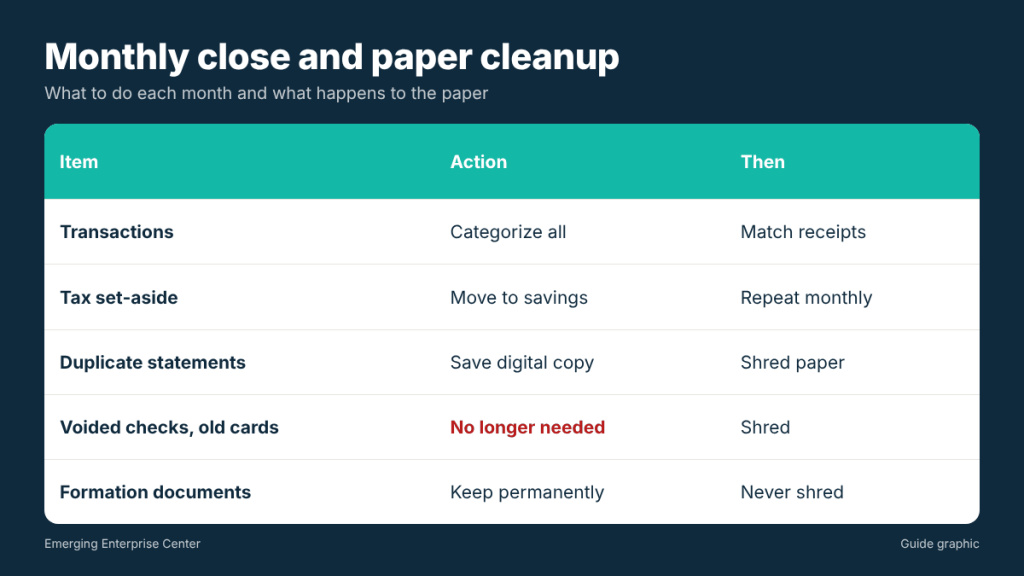
- Scan or file any paper mail that came in, then shred duplicates.
Thirty minutes a month adds up to six hours a year (30 times 12 equals 360 minutes), which is usually far less time than a single weekend spent untangling a year of mixed accounts.
Warning signs your finances are still mixed
Even owners who opened a business account sometimes drift back into old habits. Watch for these signs, and fix them at your next monthly close:
- Client payments still landing in a personal account through an old payment link or invoice template
- Subscriptions for business software billed to a personal card
- Cash withdrawals from the business account with no record of what they paid for
- Business statements and tax forms arriving at your home mixed in with household mail
- Paying a personal bill directly from business checking “just this once”
- No idea what the business earned last month without opening three different apps
Each one is easy to fix on its own: update the payment link, move the subscription, record the withdrawal, change the mailing address on the account, repay the personal bill. The goal is not perfection on day one. It is a system that catches drift every month before it becomes a year-end cleanup project.
Secure disposal of old financial paper
Separating finances creates its own paper trail: bank statements, card statements, check stubs, voided checks, deposit slips and receipts. Once you have digital copies and you are past the retention period your tax advisor recommends, this paper becomes a liability. It contains account numbers, signatures and business details that are useful to fraudsters.
- Shred voided checks and old checkbooks if you close an account.
- Shred duplicate statements once the electronic version is saved.
- Shred expired cards and any mail with account numbers.
- Keep formation documents, EIN confirmation and other permanent records safe and never shred them.
Frequently asked questions
Is it illegal to use my personal account for business?
Not by itself for a sole proprietor, but it makes taxes harder. For an LLC or corporation, commingling funds can weaken your liability protection.
Can I use my personal credit card for one business purchase?
Yes, if you have the business reimburse you with a documented transfer and keep the receipt.
How much should I set aside for taxes?
It depends on your income, structure and state. Ask a tax professional to help you pick a percentage, then automate the transfer.
Do I need bookkeeping software?
Not on day one, but it helps once you have regular transactions. Even a spreadsheet works if you update it monthly.
This article is general information, not legal or tax advice. Talk with a qualified professional about your specific situation.
Old statements and receipts piling up?
Once your records are scanned and past their retention period, walk-in document shredding in Houston is a quick way to destroy them securely.