
You live in Texas, but the paperwork belongs somewhere else. Maybe you are selling a parent’s house in another state, signing an affidavit for a court case in California, closing a business account with an out-of-state bank or giving a relative a power of attorney back home. The document arrives with instructions to “sign before a notary,” and it was clearly written with another state’s laws in mind. Can a Texas notary handle it, and will the other state accept it?
In most cases, yes. But out-of-state documents come with a few predictable snags: certificate wording that references another state, venue lines that name the wrong county, witness requirements that Texas does not have, and recipients with their own preferences. This guide explains how interstate notarization generally works, what to check before your appointment, and how to avoid sending a document back across the country twice.
How interstate notarization generally works
A notary performs a notarial act under the law of the state that commissioned them. A Texas notary follows Texas rules when verifying your identity, administering an oath and completing the certificate, no matter where the document is headed.
The receiving state then decides whether to accept it. Most states recognize notarial acts performed by notaries commissioned in other states, which is why a document notarized in Houston is routinely accepted in other states. Problems tend to come not from the notarization itself, but from the document’s own requirements, such as extra witnesses or specific certificate language.
One important point: notarization happens where you are, not where the document is going. If you sign in Harris County, Texas, the notarization takes place in Texas, and the certificate should say so.
The parts of the document to check first
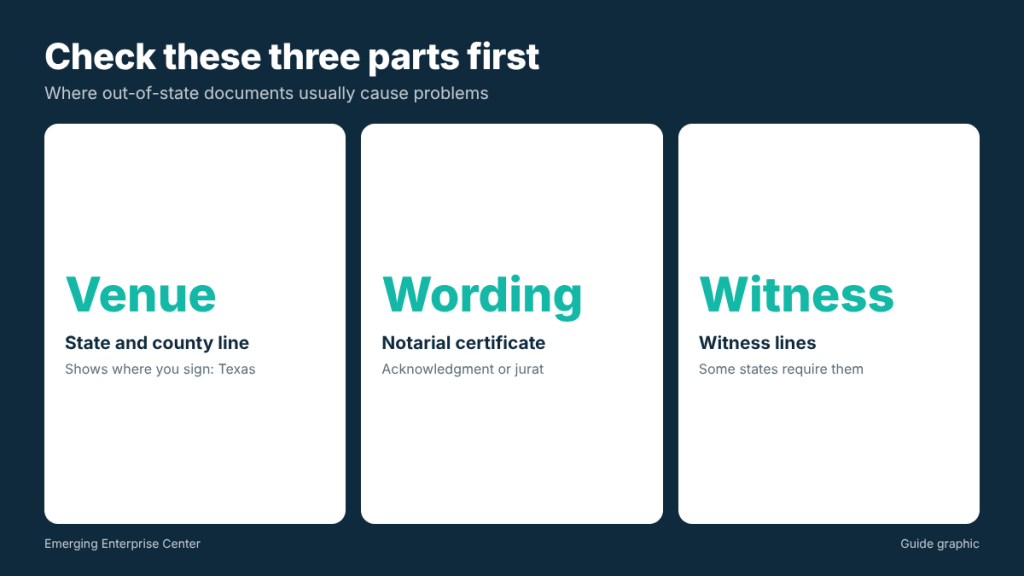
The venue
Most notarial certificates begin with a venue line, such as “State of ______, County of ______.” It states where the notarization takes place. Documents prepared elsewhere often have the other state and county pre-printed. The notary will typically need the venue to reflect the Texas county where you are actually signing, and may correct it as part of completing the certificate.
The notarial certificate
The certificate is the wording the notary signs and seals. It tells the reader what kind of notarial act was performed, most commonly an acknowledgment (you confirm you signed) or a jurat (you swear to the contents and sign in front of the notary). Out-of-state certificates may refer to that state’s statutes or include wording a Texas notary cannot truthfully certify. In those cases, the notary may need to use or attach Texas-compliant wording.
A notary cannot choose the type of notarization for you or advise on which certificate the recipient needs. If the document has no certificate or you are unsure which type is required, ask the person or office that sent it.
Witness requirements
Some states require one or more witnesses, in addition to a notary, for certain documents, especially real estate deeds and some estate documents. Texas generally does not require witnesses for many of these same documents, so Texas notaries may not provide them automatically. If your document has witness lines, plan to bring witnesses or ask in advance whether the notary location can help.
Step-by-step: getting an out-of-state document notarized in Texas
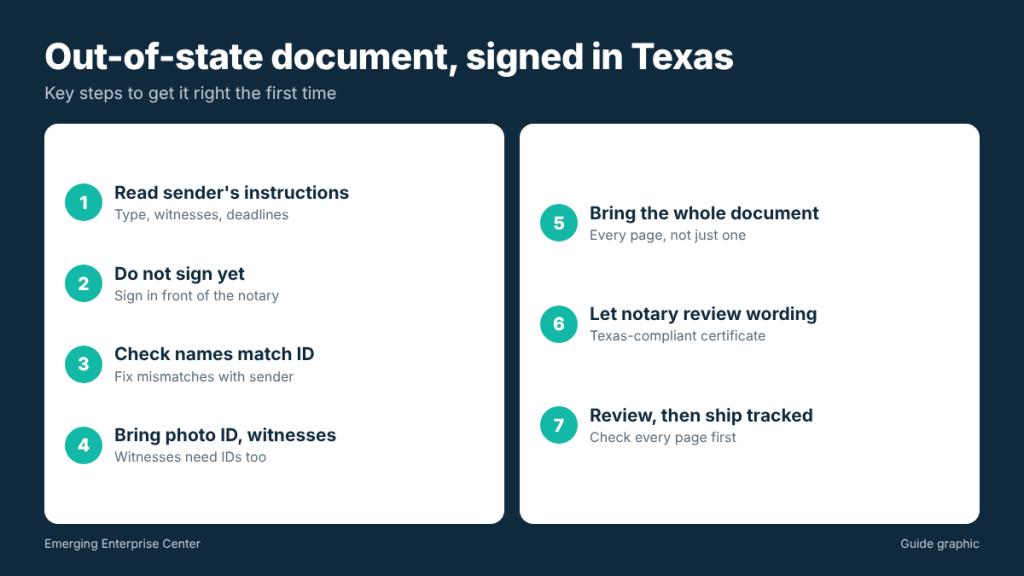
- Read the instructions from the sender. Look for required notarization type, witness requirements, ink color preferences and deadlines.
- Do not sign yet. Wait until you are in front of the notary, especially for jurats, which require signing in the notary’s presence.
- Check names. Make sure your name on the document matches your ID. If it does not, contact the sender before your appointment.
- Bring valid photo ID and, if needed, your witnesses with their IDs.
- Bring the whole document, not just the signature page. Notaries generally need to see the full document.
- Let the notary review the certificate and venue. They will complete it in a way that complies with Texas requirements.
- Review before you leave. Check that every signature line, date, seal and initial is complete.
- Ship it with tracking. Return originals by a trackable, signature-required method if the document is valuable or time-sensitive.
Worked example: an affidavit for another state’s court
Linda lives in Houston and needs to sign an affidavit for a probate matter in another state. The attorney emails a document with that state’s name and county already printed in the venue. Linda prints all six pages, leaves the signature line blank and visits a notary with her driver’s license. The notary administers the oath, has her sign, completes the jurat with “State of Texas, County of Harris” as the venue and applies the seal. Linda checks all six pages, then overnights the original to the attorney with tracking. The attorney confirms it is accepted the next day.
Common problems and how to avoid them
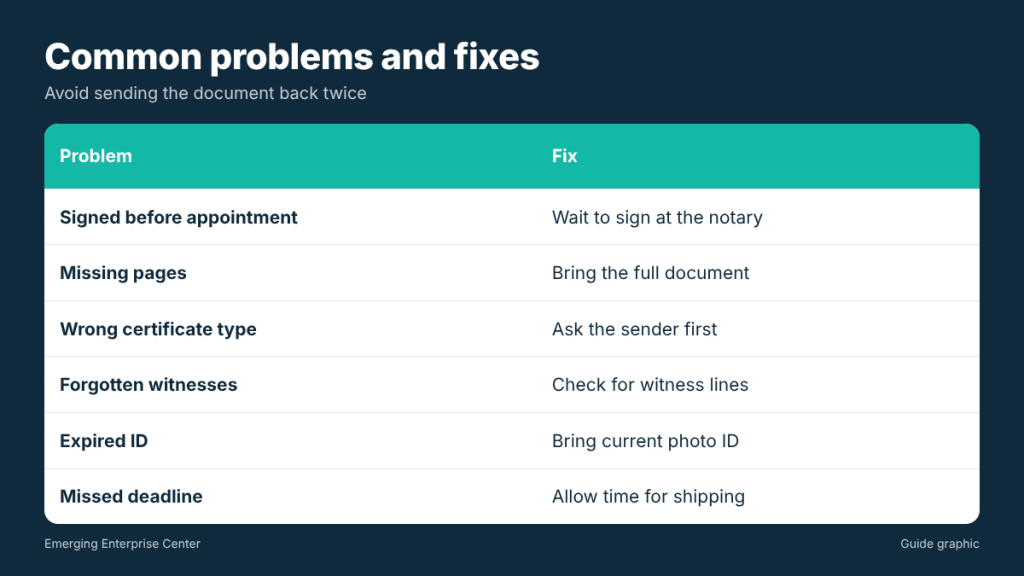
- Pre-signed documents. Signing at home before the appointment can mean starting over with a fresh copy, especially for sworn statements.
- Missing pages. Bringing only the signature page can prevent notarization or lead the recipient to reject it.
- Wrong certificate type. If the sender wanted an acknowledgment but the document only has jurat wording, it may be rejected. Ask the sender when unsure.
- Forgotten witnesses. Real estate deeds bound for some states may need witnesses. Check before you go.
- Expired ID. Bring a current, unexpired government photo ID. A driver’s license or passport is the safest choice.
- Missed deadlines. Courts, closings and banks often set firm dates. Allow time for the appointment and for overnight shipping back.
- Name mismatches. Middle names, suffixes and recent name changes can cause problems. Fix them with the sender first.
When the recipient asks for more than a notary
Occasionally, a receiving office asks for extra steps:
- Proof of the notary’s commission. Rare for interstate use, but some recipients ask for confirmation. The Texas Secretary of State oversees notary commissions and authentication of notarized documents and can explain the current options.
- An apostille. Apostilles are used for documents going to foreign countries under an international convention, not for documents moving between US states. If someone asks for one for interstate use, ask them to confirm.
- Original “wet ink” signatures. Some offices do not accept faxed, scanned or electronically notarized documents. Ask before choosing a method.
Tips for business owners
If your company does business in several states, out-of-state notarizations become routine: foreign qualification filings, bank resolutions, vendor forms and real estate paperwork. A few habits help:
Build a short internal routine so these requests do not derail your week. When an out-of-state document arrives, one person reads the sender’s instructions, confirms the notarization type and witness needs, prints the full document and books a notary visit. Another confirms the return shipping address and deadline. Splitting the steps this way catches most mistakes before anyone signs.
- Keep a scanned copy of every notarized document before you mail the original.
- Know your title and signing authority for the entity, and bring proof if the recipient requires it.
- Track deadlines from the date the recipient needs the original, then work backward to allow for shipping.
- Keep a list of notary locations near your office that accept walk-ins.
Frequently asked questions
Can a Texas notary notarize a document for use in another state?
Generally yes. The notary follows Texas law, and most states recognize notarizations performed in other states. Check the document’s own requirements.
Should the venue say Texas or the other state?
The venue reflects where the notarization happens. If you sign in Texas, the venue should show Texas and the county where you signed.
Do I need witnesses?
Only if the document or the receiving state requires them. Look for witness lines and read the sender’s instructions.
Can the notary tell me which certificate to use?
No. Notaries cannot give legal advice or choose the notarization type. Ask the sender, the receiving office or an attorney.
This article is general information, not legal advice. Requirements vary by state and document; confirm with the receiving office or an attorney.
Out-of-state paperwork to sign in Houston?
Bring the full, unsigned document and your photo ID to a walk-in notary near the Galleria and ship the original back the same visit.