
Some of the most important documents a family ever signs are signed under the hardest conditions: a parent in the hospital who needs to name someone to handle finances, a grandparent in assisted living updating a property document, or a spouse recovering from surgery who must sign before a deadline. These signers often cannot travel, may not have a current ID, and may tire quickly. Families understandably want it done fast. Notaries, meanwhile, have rules they must follow to protect the very person who is signing.
This guide explains what a notary needs when the signer is elderly, ill or in a care facility, how to prepare so the appointment succeeds the first time, why a notary may pause or decline, and how families can protect a vulnerable relative throughout the process. It is written for family members and caregivers who are organizing the signing.
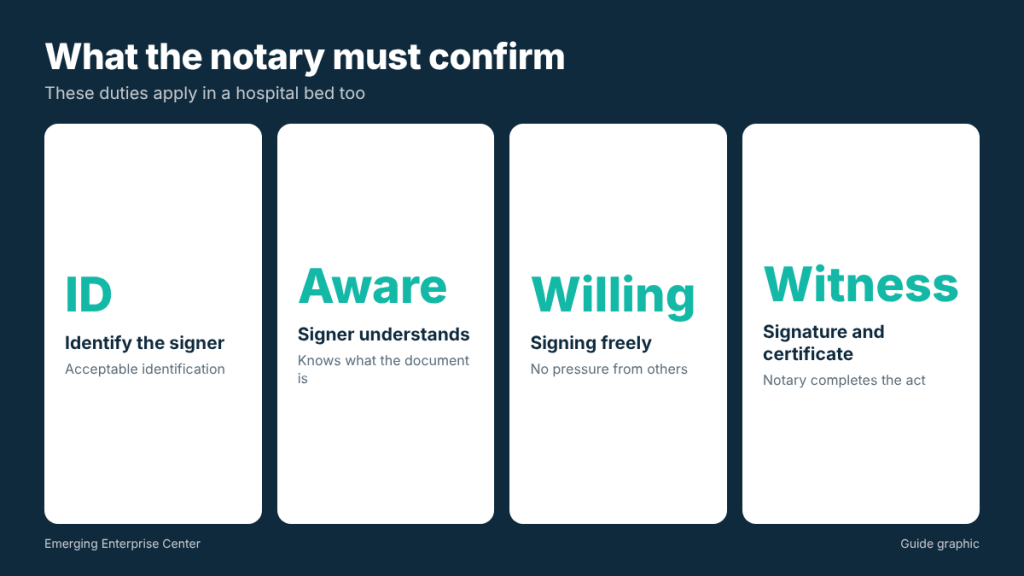
What the notary must confirm, no matter the setting
A notary’s core duties do not relax because a signer is in a hospital bed. In every notarization, the notary generally needs to:
- Identify the signer using acceptable identification.
- See that the signer appears aware of what they are signing, meaning they seem to understand the nature of the document.
- See that the signer is willing, meaning they are signing freely and not under pressure from anyone in the room.
- Witness the signature or acknowledgment and complete the notarial certificate.
A notary is not a doctor and does not perform a medical evaluation. But if the signer cannot communicate, seems confused about what the document is, or appears to be pressured, the notary may decline. That protects the signer and the document, since a notarization performed under doubtful conditions invites later challenges.
Identification problems and how to solve them
Older signers often have an expired driver’s license, or their ID is at home while they are in the hospital. Solve this before the notary arrives:
- Find a current government photo ID. A driver’s license, state ID card or passport is typical. Check the expiration date.
- Check the name. The name on the ID should match the name on the document. Married names, middle names and suffixes cause frequent problems.
- Ask about alternatives early. Some states, including Texas in certain circumstances, allow identification through a credible witness who knows the signer. Rules are specific, so ask the notary in advance what they can accept.
- Consider getting a state ID. If there is time, a current state identification card avoids problems for this and future signings.
Arranging a notary in a hospital or care facility
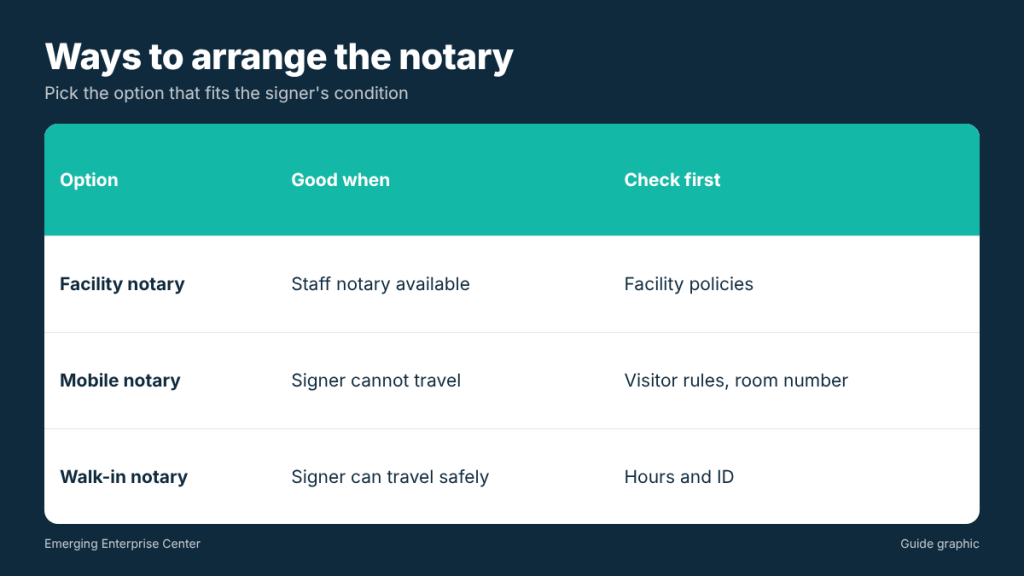
You have a few options, depending on the signer’s location and condition:
- Ask the facility. Some hospitals and senior living communities have staff notaries or can recommend one. Ask the social worker or front office about their policies.
- Book a mobile notary. Mobile notaries travel to the signer. Confirm the facility’s visitor rules, and share the room number and visiting hours.
- Bring the signer to a notary if they are mobile and the trip is safe. A walk-in notary avoids scheduling delays.
Whichever option you choose, tell the notary upfront about the setting, the type of document, how many signers and witnesses there are, and any physical limitations, such as difficulty holding a pen.
Timing the appointment
The signer’s condition can change over the day. A little planning makes a big difference:
- Schedule for the time of day when the signer is usually most alert. Nurses and caregivers often know.
- Avoid times right after strong medication, procedures or therapy sessions, when possible.
- Allow extra time. Explaining the process gently and letting the signer rest between pages helps.
- Have a backup time in mind in case the first attempt has to stop.
Documents families commonly need notarized
- Financial powers of attorney, naming someone to handle bank accounts, bills and property.
- Health care documents, such as medical powers of attorney and advance directives. Some Texas health care forms can be completed with either qualified witnesses or a notary, so read each form’s instructions carefully.
- Affidavits, for example about residency, heirship or a lost document.
- Real estate documents, such as deeds that must be acknowledged before recording.
- Vehicle and title documents, when a relative is transferring a car.
- Bank and benefits forms that require notarized signatures.
If a document has legal consequences for the signer’s property or care, consider having an attorney prepare or review it before the notary visit. A notary cannot draft the document or explain its legal effect.
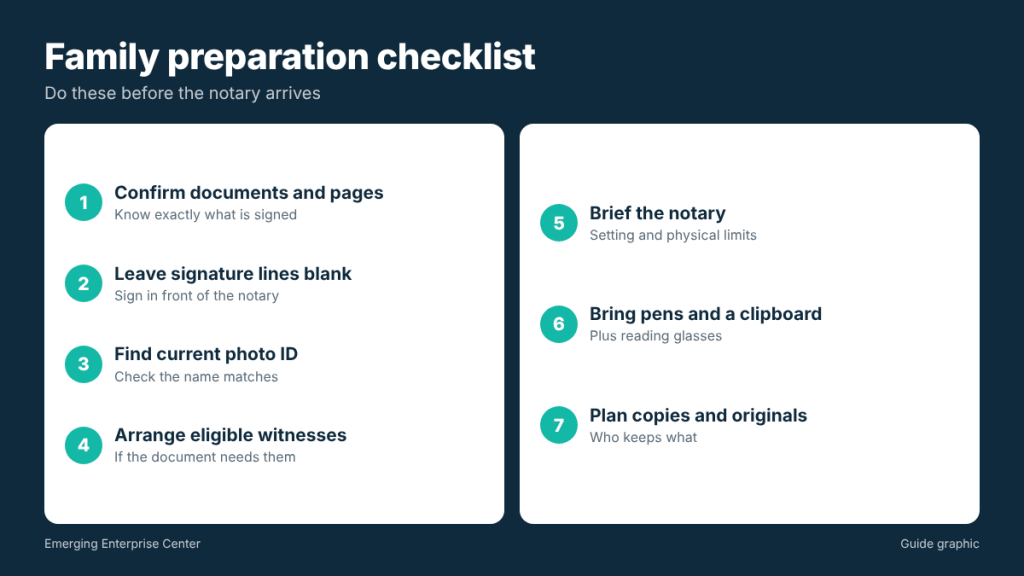
A preparation checklist for families
- Confirm the exact documents and how many pages each has.
- Leave all signature lines blank until the notary is present.
- Locate a current photo ID for the signer and check the name.
- Arrange any required witnesses and make sure they are eligible under the document’s rules (for some documents, relatives or people named in the document may not qualify).
- Tell the notary about the setting and any physical limits.
- Bring pens, a clipboard or firm surface, and reading glasses.
- Plan who will make copies and who keeps the originals.
Worked example: a hospital signing
Robert’s mother is in the hospital and wants to sign a durable power of attorney naming him as agent. Her driver’s license expired last year. Robert asks the mobile notary in advance, learns the expired ID may not be accepted, and brings her current passport from home instead. He schedules the visit for 10:00 a.m., after the nurse says she is usually most alert, and steps out of the room while the notary speaks with her privately. The document has 8 pages; she initials each and signs once. The notary completes the certificate, and Robert scans all 8 pages before filing the original safely.
After the signing
Once the notary leaves, a few final steps keep the documents useful. Scan every page, including the notarial certificate, and save the file somewhere other family members with a legitimate need can access. Store the original in a safe place, such as a fireproof box or with the attorney who prepared it. Give copies to the people or institutions that will rely on the document, such as a bank or the signer’s doctor, and note who received a copy and when.
Why a notary might pause or decline
- The signer cannot communicate or does not seem to understand what the document is.
- Someone in the room is answering for the signer or pressuring them.
- The signer’s identity cannot be confirmed with acceptable ID.
- The document is incomplete or has blank spaces that should be filled in.
- The signer cannot sign and no permitted alternative procedure is available.
A decline is frustrating, but it is a safeguard. Ask what would need to change, then reschedule. Often the fix is simple: a different time of day, a current ID, or a private conversation without relatives in the room.
Protecting a vulnerable relative
Notary rules exist partly to prevent elder financial abuse. Families can help by letting the notary speak directly with the signer, stepping back from the conversation, avoiding last-minute document changes, and keeping copies of everything signed. If you suspect someone is pressuring an older adult to sign, contact Adult Protective Services or an attorney.
Frequently asked questions
Can I sign for my parent if they cannot sign?
Not without legal authority, such as a valid power of attorney. Ask the notary about permitted procedures for signers who cannot sign in the usual way.
Can family members be in the room?
Often yes, but the notary may ask to speak with the signer privately to confirm awareness and willingness.
What if my parent has no valid ID?
Ask the notary in advance what alternatives they can accept. Getting a current state ID card may be the most reliable fix.
Can the notary explain the document to my parent?
No. Notaries cannot give legal advice. An attorney can explain the document’s effect before the signing.
This article is general information, not legal advice. For documents affecting property, health care or finances, consult a licensed attorney.
Can your relative travel to a notary?
If they can make the trip, The Postal Spot offers walk-in notary service in Houston with no appointment, so you can come when they are feeling up to it.