Running a business from a one-bedroom apartment works fine until the boxes start arriving. Supplier samples pile up in the leasing office, a carton of inventory sits in the hallway for six hours, and the package locker sends you a code for a box that is too big to fit. If you need to receive business packages at apartment addresses, you are dealing with three problems at once: limited space, shared delivery areas you do not control, and building rules that were written with personal deliveries in mind.
This guide looks at why apartment package delivery breaks down for small businesses, the options available (from building lockers to carrier hold services to a private mailbox), how to estimate your monthly package load, and how to set up a delivery system that protects your inventory, your neighbors’ patience and your lease. The right choice depends on how many packages you receive, how valuable they are and how often you need them in hand.
Why apartment deliveries fail for business owners
Apartment package systems are built for the occasional personal order, not a steady stream of business shipments. The common failure points:
- Locker capacity. Smart lockers fill up fast, and oversized boxes do not fit at all. Carriers then leave the item at the office, in a hallway, or take it back.
- Leasing office hours. Packages held at the office are only available when it is open, which may not match your schedule.
- Theft and misdelivery. Boxes left in shared areas are exposed, and drivers sometimes leave items at the wrong door or building.
- Signature-required shipments. If no one answers, the carrier leaves a notice and you have to arrange redelivery or pickup.
- Lease and management rules. Some properties limit the number or size of packages they hold, charge for storage, or restrict commercial activity in units.
- Freight shipments. Pallets and large deliveries usually cannot reach upper floors or be left in common areas.
How to receive business packages at apartment buildings: your main options
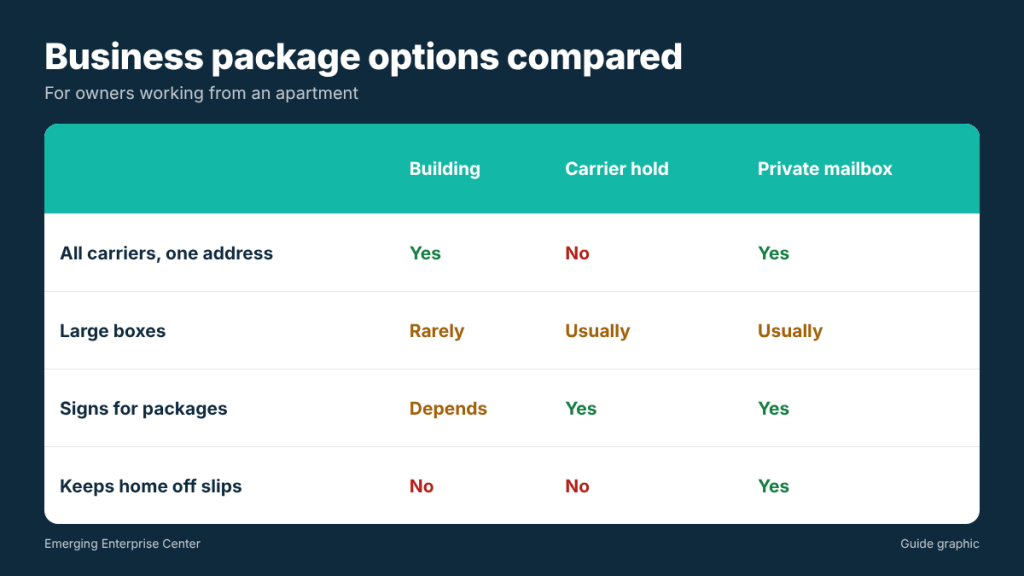
1. Use the building’s lockers and office, with limits
For a handful of small packages a month, the building system may be enough. Read your lease and the management’s package policy, find out how long they hold items, and ask whether there is a size or volume limit. Be courteous: management staff who are overwhelmed by your inventory are more likely to enforce rules.
2. Carrier hold-at-location services
FedEx, UPS and USPS all offer ways to have packages held at a carrier location or partner store for pickup. This avoids porch theft and missed signatures, but you need to set it up per shipment or through your carrier account, and you have to pick up from wherever the carrier chooses. It also does not help with suppliers who ship using their own settings.
3. A private mailbox with a street address
A private mailbox at a mail and shipping store gives you a real street address (formatted with a suite or box number) where packages from every carrier can be delivered. Staff sign for items, store them securely, and typically notify you when something arrives. Because it is your business address, you can give it to every supplier once and stop worrying about delivery instructions. To open one, you complete USPS Form 1583 with two forms of ID (one with a photo), signed before the store’s staff or a notary.
4. A digital mailbox for letters plus package notifications
If you also receive a lot of business letters, a digital mailbox adds scanning and online management. You see envelopes and package notifications in an app and pick up when convenient.
Estimate your monthly package load first
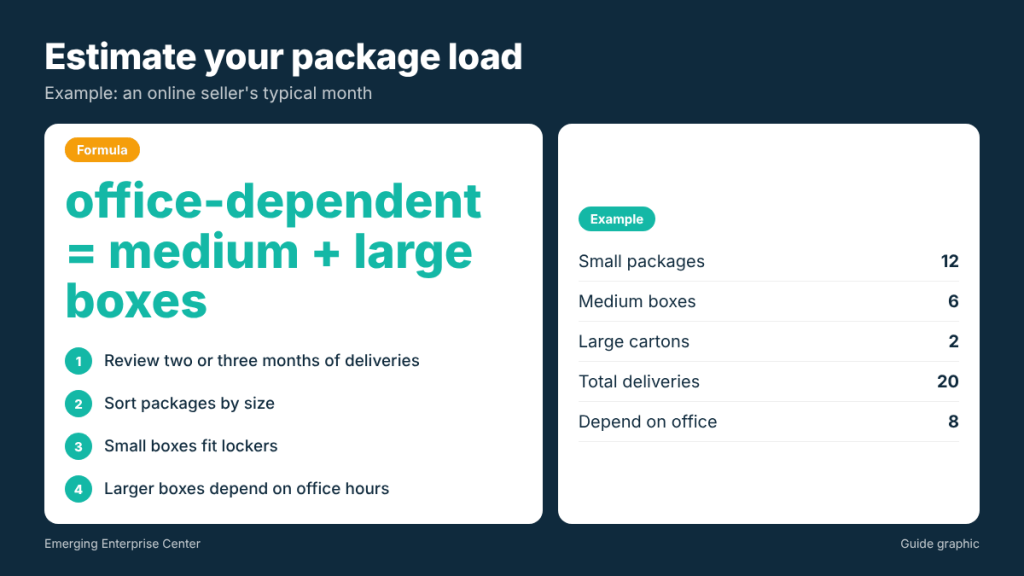
Before you choose, count what you actually receive. Look back at the last two or three months of orders and deliveries and sort them by size.
Here is an example. Suppose an online seller receives 12 small packages, 6 medium boxes and 2 large cartons in a typical month, for a total of 20 deliveries. If the building lockers handle small packages reliably but medium and large boxes go to the office, then 8 of the 20 deliveries (6 plus 2) depend on office hours and space each month. If the office holds items for only a few days and the owner travels, several of those 8 could be returned or mishandled. That pattern points to moving business deliveries to a private mailbox while leaving personal deliveries at home.
What to ask a mail store before you sign up
- Do you accept packages from every carrier, including FedEx, UPS, DHL, Amazon and freight?
- Is there a size or weight limit on packages you will hold?
- How long will you hold packages before charging storage or returning them?
- How will I be notified when something arrives: text, email or app?
- Will you sign for signature-required items on my behalf?
- What are your pickup hours, and is there extended access?
- Can you ship items back out if I need to return or resend them?
The last question matters more than it sounds. If the store also handles shipping, you can receive a supplier’s box, repack it and send it to a customer in one trip, without ever carrying inventory up three flights of stairs.
Setting up a clean delivery system
Once you have chosen your business delivery address, set it up deliberately:
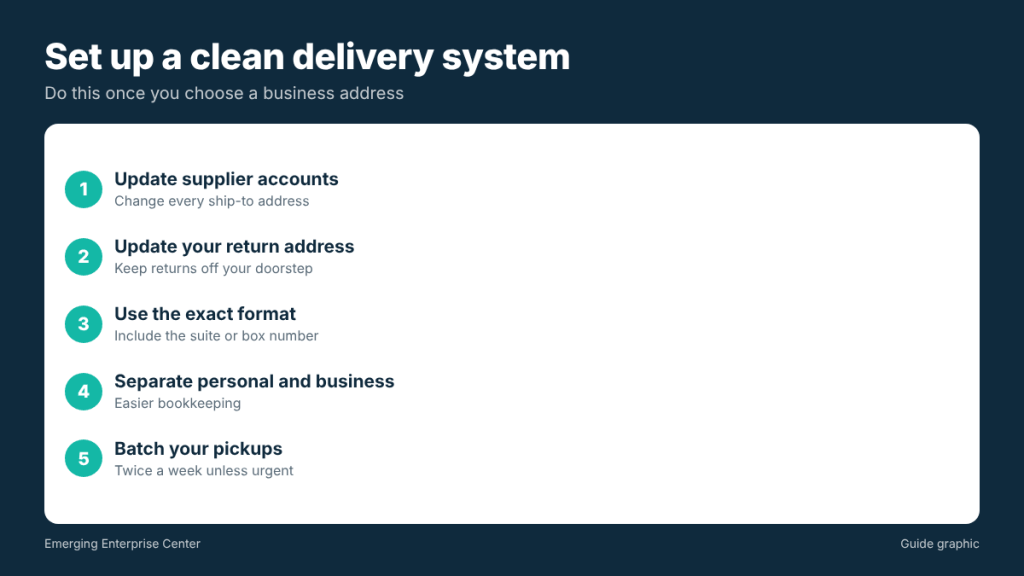
- Update supplier and marketplace accounts. Change your ship-to address everywhere you buy inventory or supplies.
- Update your return address. If you sell online, use your business address for returns too, so customers’ returns do not land at your apartment.
- Use a consistent format. Include the suite or box number exactly as the store instructs so packages are logged correctly.
- Keep personal and business deliveries separate. This makes bookkeeping easier and keeps your home address off packing slips.
- Batch your pickups. Collect packages on a set schedule, such as twice a week, unless something is urgent.
Protecting your lease and your neighbors
Even with a separate delivery address, a home-based business in an apartment should stay low-key. Check your lease for clauses on business use, storage and customer visits. Avoid storing large quantities of inventory in shared spaces, and do not have customers pick up orders at the building unless management allows it. Using an outside address for business packages is one of the simplest ways to keep your business invisible to the property manager.
Handling freight and oversized shipments
If you buy inventory by the pallet, an apartment is not a realistic delivery point. Freight carriers typically need a loading dock or a liftgate and a ground-level location, and they will not carry pallets upstairs. Ask your supplier whether a commercial address is required, and look for a shipping store or warehouse partner that can receive freight. Breaking a pallet into parcels for pickup can also work, depending on what the receiving location offers.
Frequently asked questions
Can my apartment complex refuse to hold my business packages?
Management sets its own package policy, and many limit how long or how many items they hold. Check your lease and the property’s rules.
Will Amazon deliver to a private mailbox?
Amazon and other major carriers generally deliver to private mailbox street addresses. Use the address format the mail store gives you.
Is a private mailbox address better than a PO Box for packages?
For business packages, yes. A standard PO Box generally cannot receive FedEx or UPS deliveries, while a private mailbox accepts all carriers.
Can I use my mailbox address for returns from customers?
Yes, and many sellers do. It keeps returned items, and your home address, away from your apartment.
Running out of room for business deliveries?
Houston sellers and service businesses can route deliveries to a Postal Spot mailbox that accepts packages from all carriers and pick them up near the Galleria.