
The form that creates a Texas LLC is only a few pages long, but nearly every line has consequences. The name you enter becomes your legal name. The registered agent you list will receive lawsuits on your behalf. The management choice shapes who can sign contracts. And everything on it becomes a public record. Before you file your Texas LLC certificate of formation, it helps to understand what each section is asking and why.
This guide walks through Form 205, the Certificate of Formation for a Limited Liability Company, section by section. For each part you will find what the state is asking for, the common choices, and the mistakes that lead to rejections or regret. Forms are updated from time to time, so download the current version and its instructions from the Texas Secretary of State before you file. This is general information, not legal advice; consider an attorney for multi-owner or complex LLCs.
Before you start: what you need on hand
- Your chosen LLC name, already checked against Secretary of State records
- The name and Texas street address of your registered agent, and the agent’s consent
- Whether the LLC will be managed by members or managers
- Names and addresses of the initial members or managers
- The organizer’s name and address (the person signing and submitting the form)
- A business mailing address for correspondence
- Payment for the filing fee: $300 for a Texas LLC certificate of formation, according to the Secretary of State’s fee schedule
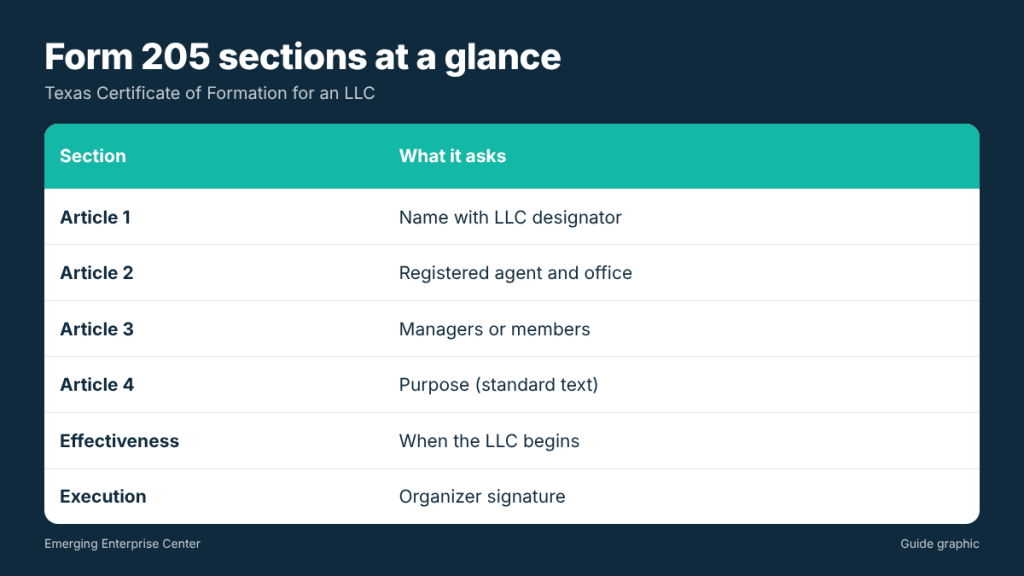
Article 1: entity name and type
Enter the LLC’s name exactly as you want it on the public record, including an organizational designator such as “Limited Liability Company,” “Limited Company,” “LLC” or “L.L.C.” The name must be distinguishable from names already on file. Check spacing and punctuation carefully: “Blue Oak Studio LLC” and “BlueOak Studio LLC” are different names on paper, and the one you file is the one your bank will expect.
Common mistake: leaving off the designator, or picking a name that is too similar to an existing entity. Either can cause a rejection.
Article 2: registered agent and registered office
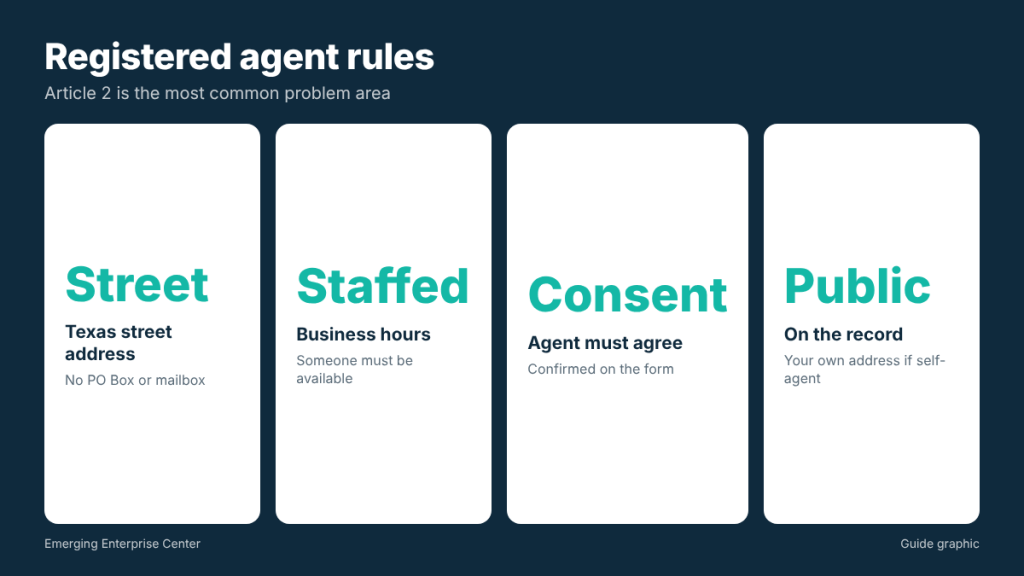
This section names the person or company that will accept legal papers for the LLC. You choose either an organization (such as a commercial registered agent service) or an individual, and you list the registered office: a street address in Texas where the agent can be found during business hours.
- A PO Box or private mailbox cannot be the registered office.
- The agent must consent to serve. The form includes a statement confirming that consent has been obtained.
- If you serve as your own agent, your address becomes public and you must be reliably available there during business hours.
Common mistake: listing a mailbox as the registered office, or naming a friend without their consent.
Article 3: governing authority
Here you choose how the LLC is managed:
- Managed by managers: you list the initial managers. Managers run the business; members may be passive owners.
- Managed by members (no managers): you list the initial members, who run the business directly.
For each person listed, you provide a name and address. These addresses are public. Many owners list a business mailing address, such as a private mailbox with a street address, instead of their home.
How to choose: a single owner who runs the business usually picks member-managed. If some owners invest but should not make daily decisions, manager-managed may fit better. Your operating agreement (Texas calls it a company agreement) then spells out the details.
Article 4: purpose
Form 205 includes standard language that the LLC may engage in any lawful purpose for which LLCs may be organized in Texas. Most businesses leave it that way. Certain professional businesses, such as some licensed professions, have special rules and may need to form a professional LLC instead. If you are in a licensed profession, check before you file.
Supplemental provisions and information
This optional section lets you add provisions to the certificate itself. Most small LLCs leave it blank and put their internal rules in the company agreement, which stays private. Adding provisions here puts them on the public record and makes them harder to change, because amendments require another filing.
Organizer
The organizer is the person who prepares and signs the certificate. It can be you, an attorney or a filing service. The organizer’s name and address appear on the form. The organizer does not have to be a member or manager.
Effectiveness of filing
You choose when the LLC comes into existence:
- When filed by the Secretary of State (the most common choice)
- On a later date that you specify, within the window the form allows
- When a specified event or fact occurs, also within the allowed window
A delayed effective date can make sense for tax or accounting reasons, such as starting the LLC on the first day of a new year. Read the form instructions for the limits on delayed dates.
Execution
The organizer signs the certificate. By signing, the organizer affirms that the statements are true and that they are authorized to file. Making a materially false statement on a filed document can carry penalties, so double-check names and addresses before signing.
Filing your Texas LLC certificate of formation and what happens next
- File online through SOSDirect or by mail or fax, following the current instructions.
- Pay the $300 filing fee.
- Wait for approval. You will receive a file-stamped certificate when the filing is accepted.
- Get an EIN from the IRS, open a business bank account and sign your company agreement.
- Register with the Texas Comptroller for franchise tax and, if needed, sales tax.
- File an assumed name certificate if you will operate under a name other than the legal name. The fee schedule lists Form 503 at $25.
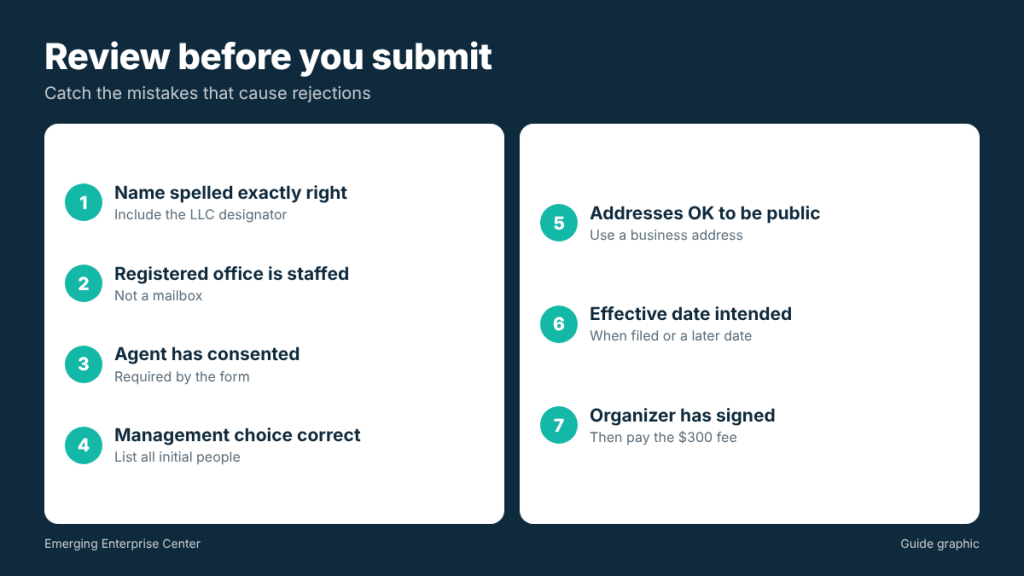
A quick review checklist before you submit
- Is the name spelled exactly as you want, with the designator?
- Is the registered office a staffed Texas street address, not a mailbox?
- Has the registered agent consented?
- Is the management choice correct, with every initial member or manager listed?
- Are the addresses you listed ones you are comfortable making public?
- Is the effective date what you intend?
- Has the organizer signed?
Changing the certificate later
Your certificate is not permanent. If you change the LLC’s name, switch from member-managed to manager-managed, or add provisions, you file a certificate of amendment with the Secretary of State. A change of registered agent or registered office uses a separate statement of change. Each filing has its own form and fee, which you can find on the Secretary of State’s website. Updating your company agreement at the same time keeps your private records consistent with the public ones.
Frequently asked questions
Can I list a private mailbox anywhere on Form 205?
Not as the registered office. You can often use a business mailing address, such as a private mailbox, for the addresses of members, managers or the organizer, depending on the form’s instructions.
Do I need to list all owners on the certificate?
For a member-managed LLC, you list the initial members. For a manager-managed LLC, you list the managers, and members may not appear. Ownership details belong in your company agreement.
Does the certificate need to be notarized?
Form 205 is signed by the organizer and is not typically notarized. Read the current form instructions to confirm.
What if my filing is rejected?
The Secretary of State will explain why. Correct the issue, often the name or registered agent section, and resubmit.
Want a business address for the public sections of your filing?
Houston founders can use a business mailbox from The Postal Spot as their mailing address, where the form allows, and keep their home off the public record.