
Within weeks of forming a business, many owners start receiving letters that look urgent and official: a “compliance notice” with a state seal-style logo, an “annual records statement” with a payment slip, or a renewal invoice for a listing they never ordered. Some of these are real government mail. Many are solicitations from private companies designed to look like bills, and a few are outright fraud. Because new business filings are public, fresh LLCs and trademark applicants are easy targets.
This guide shows you the most common official-looking business mail scams, the red flags that give them away, a quick verification routine you can teach anyone who opens your mail, and what to do with these letters afterward. The goal is simple: pay every real bill on time and never pay a fake one.
Why new businesses get so much of this mail
When you file a certificate of formation, register an assumed name, apply for a trademark or record a property deed, your business name and address become part of a public record. That is how the system is supposed to work: the public can look up who owns a business. The side effect is that companies scrape those records and mail offers to every new filer.
Some of those offers are legitimate services sold at a markup, such as ordering a copy of a document you could get directly from the agency. Others cross the line by implying you are legally required to pay them. The letters are often timed to arrive near real deadlines, which makes them feel credible.
The most common types to watch for
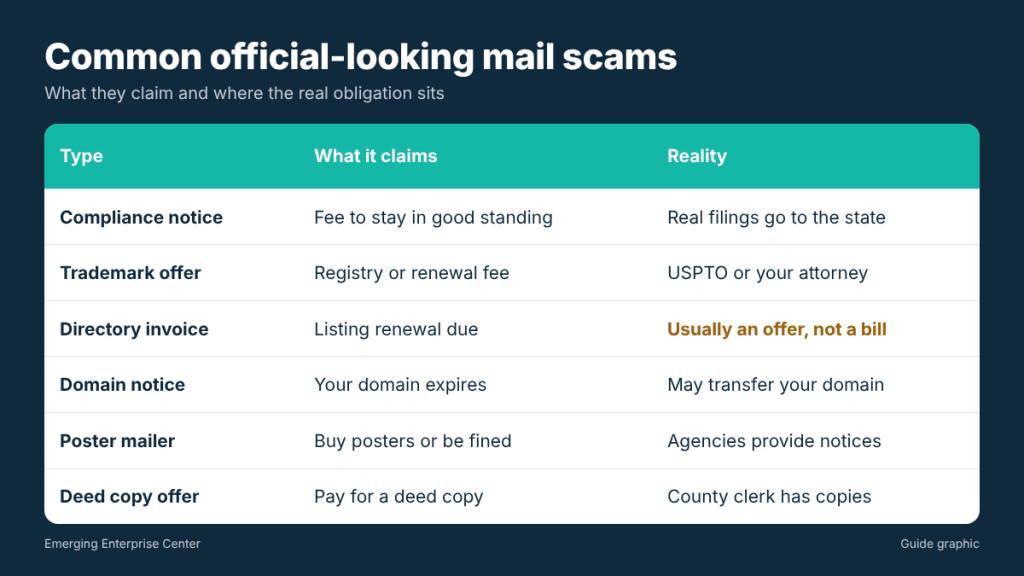
Fake compliance and annual report notices
These letters suggest your business must file a form or pay a fee to stay in good standing, often with a deadline and a penalty warning. They may reference “annual minutes,” “certificate of status” or “compliance services.” In Texas, your real annual obligations generally run through the Texas Comptroller (franchise tax and the related information report) and, for changes to your entity, the Secretary of State. A private company may offer to prepare filings for you, but it cannot make them mandatory.
Trademark and patent solicitations
After you file a trademark application, your filing information is public. Owners often receive notices offering “registration in a private database,” “monitoring” or “renewal” that look like they come from the trademark office. The USPTO itself warns trademark owners about misleading solicitations. Official correspondence on your application comes from the USPTO or your attorney of record.
Directory and listing invoices
These look like invoices for a business directory, map listing or “yellow pages” style service. The fine print usually says it is an offer, not a bill. If you sign or pay, you may be agreeing to an ongoing subscription.
Domain name renewal notices
A letter warns that your domain is expiring and offers to renew it. Paying may transfer your domain to a different registrar, often at a higher price. Your real registrar typically contacts you by email through the account you already use.
Labor law poster and workplace compliance mailers
These claim you must buy a poster set to avoid fines. Employers do have posting requirements, but required federal and state notices are generally available directly from the issuing agencies. Check before you buy.
Property record and deed copy offers
If your business buys real estate, you may get a letter offering a certified copy of your deed for a fee. Copies are usually available from the county clerk directly.
Red flags that give a scam letter away
Teach everyone who opens your mail to look for these signs:
- A name that sounds governmental but is not an agency, such as “Business Compliance Division” or “Records Filing Service.”
- Fine print stating “this is not a bill” or “this is a solicitation.” Required disclosures are often in tiny text at the bottom or on the back.
- Urgent deadlines and penalty warnings with no reference to a specific statute, case number or account you recognize.
- A return address or payment address in another state for something that should come from a Texas agency.
- Payment to a private company for something you normally file with the state, IRS or USPTO directly.
- Information pulled from public records, such as your formation date or filing number, used to look authoritative.
- Pressure to call a number on the letter instead of the agency’s published contact information.
A five-minute verification routine
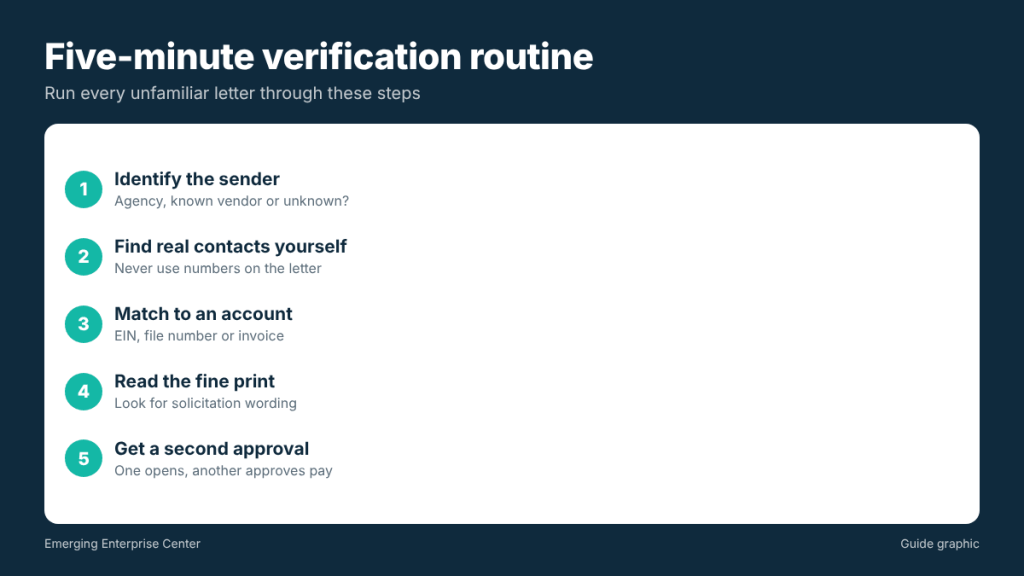
Before any official-looking letter is paid, run it through these steps:
- Identify the sender. Is it a government agency, a vendor you already work with, or a company you have never heard of?
- Find the real contact independently. Look up the agency or vendor’s official website or phone number yourself. Never use contact details printed on the suspect letter to verify it.
- Match it to an account or filing. Real notices reference something you can confirm: an EIN, a taxpayer number, a file number or an invoice from an existing relationship.
- Read the fine print. Look for “solicitation,” “not affiliated with” or “not a government agency.”
- Get a second approval for anything unfamiliar. One person opens, another approves payment. This simple split stops most fake invoice losses.
Worked example: the “annual records” letter
A two-person LLC receives a letter titled “Annual Records Requirement” with a payment stub and a 15-day deadline. The office manager checks the sender: a private company with an out-of-state address. She looks up the Texas Comptroller and Secretary of State websites directly and confirms the company’s real reports are handled there, with no fee owed to this sender. The back of the letter says, in small type, that it is not a government agency. Total time: about five minutes. Money saved: the full amount on the stub.
What to do after you spot one
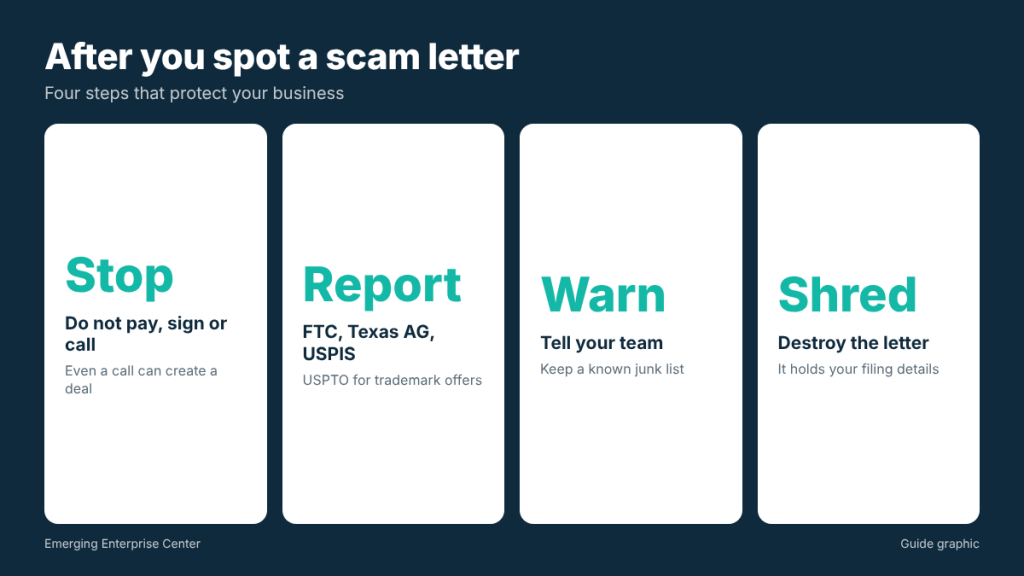
- Do not pay, sign or call. Even a call can lead to a recorded “agreement.”
- Report it if it looks deceptive. You can report misleading solicitations to the Federal Trade Commission, the Texas Attorney General’s consumer protection division, and mail fraud to the US Postal Inspection Service. For trademark solicitations, the USPTO collects reports too.
- Warn your team. Keep a short “known junk” list so the same sender is recognized next time.
- Shred it. These letters contain your business name, filing numbers and sometimes account details. Do not toss them whole into the recycling bin. Securely shredding them keeps that information out of the wrong hands.
If you already paid, contact your bank or card issuer right away to ask about disputing the charge, and keep a copy of the letter and any receipts as evidence before shredding the rest. If you signed something or gave out account details, also review your accounts for unfamiliar activity and consider changing passwords on any business portals mentioned in the letter. The sooner you act, the more options you usually have.
Reduce the volume over time
You cannot stop public records from being public, but you can reduce how much this mail disrupts you:
- Use a dedicated business mailing address so solicitations do not land at your home.
- Route mail through a single person or a scanning service so everything is screened the same way.
- Set calendar reminders for your real deadlines, such as franchise tax reports, so a fake deadline cannot create doubt.
- Keep a one-page list of the agencies and vendors you actually pay, with their official contact details.
Frequently asked questions
Are these letters illegal?
Some are legal solicitations that include required disclaimers. Others are deceptive or fraudulent. Either way, you are not obligated to buy anything from a company you did not hire.
How can I tell a real IRS letter from a fake?
Real IRS notices reference your account and include a notice number. Verify by contacting the IRS through the phone numbers on its official website, not the number on the letter.
Should I keep scam letters as records?
Keep one copy if you are reporting it or disputing a charge. Otherwise, shred it so your business details are not exposed.
Why did these start right after I formed my LLC?
Formation filings are public records, and companies monitor new filings to send offers. The timing is a sign of data scraping, not of a real obligation.
Piling up letters with your business details?
Instead of tossing them in the trash, bring them to The Postal Spot’s walk-in document shredding in Houston and have them destroyed securely.