Almost every form you fill out as a new business owner asks for an address, and many of them ask for two: a physical address and a mailing address. The labels look interchangeable, but they are not. Put a mailbox where a form expects a physical location and you may get a rejected application, a frozen payment account or a missed legal notice. Put your home address everywhere and it ends up on public records, invoices and search results for years.
This guide explains the difference between a physical address and a mailing address for a business, which forms need which one, and how to set up a simple address plan that keeps you compliant while protecting your privacy. You will also find a worked example for a home-based business and a checklist you can use before you file anything.
The core difference in one sentence each
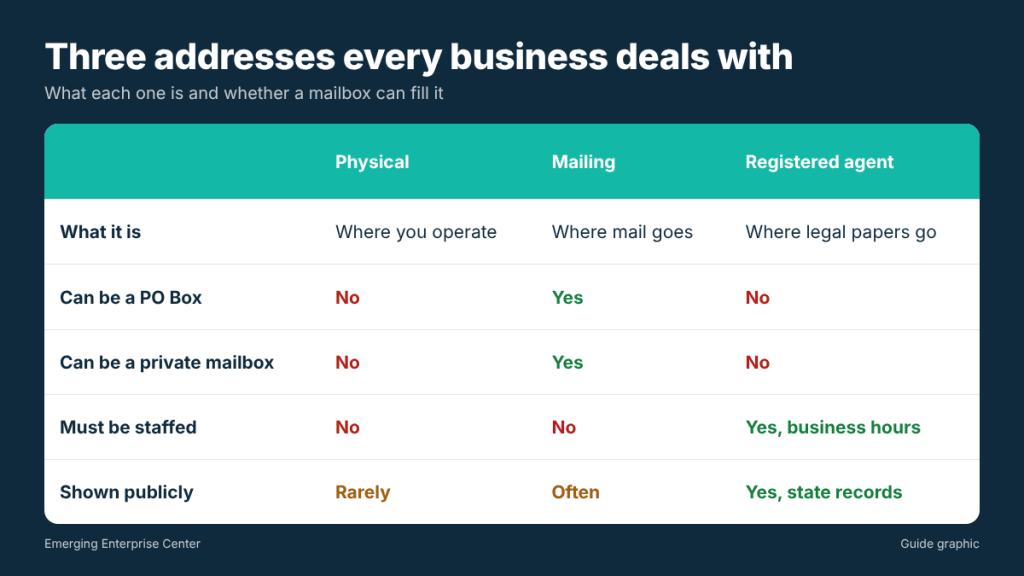
- Physical address: the place where your business actually operates, keeps its equipment or meets people. It is a location you could walk into.
- Mailing address: the place where your business receives letters and packages. It only has to reliably get mail to you.
For some businesses, the two are the same building. A bakery with a storefront uses the storefront for both. For a growing number of businesses, especially consultants, online sellers, freelancers and remote founders, the two are different. The work happens at home, in a coworking space or on the road, while mail goes to a mailbox service or a separate office.
There is also a third address that trips people up: the registered agent address. This is the place where your company accepts legal papers, and it must be a physical address staffed during business hours. It can be your physical business address, but it does not have to be.
Address types you will run into
Forms use different wording for the same ideas. Here is how to translate the most common labels:
- Principal office, principal place of business, business location: usually means where the business is run from. Read the instructions; some forms accept a mailing address here and some do not.
- Street address, physical location, site address: a real place. A PO Box will not qualify.
- Mailing address, correspondence address: where letters should go. A PO Box or private mailbox usually works.
- Registered office or registered agent address: a physical address where someone is available during business hours to accept service of process.
- Billing address: the address tied to a card or bank account. Must match what the bank has on file.
A private mailbox at a Commercial Mail Receiving Agency (CMRA) sits in an interesting middle ground. It has a real street address with a suite or box number, so it often satisfies forms that ask for a street address for mail. It is still a mailing address, though, not the place where you operate. When a form clearly asks where your business physically operates, answer honestly.
Where each address is typically required
Rules vary by agency and platform, so always read the current instructions. As a general pattern:
State business filings
When you form an LLC or corporation in Texas, the certificate of formation requires a registered agent and a registered office address. That address must be a physical location in Texas where the agent can be found during business hours. Your company’s mailing address can be separate. If you are unsure what a field means, the Texas Secretary of State publishes instructions for each form.
IRS and tax accounts
The EIN application asks for a mailing address and, if different, the street address of the business. The IRS will send notices to the mailing address you provide, so pick one you check reliably. State tax accounts, such as a Texas sales tax permit, generally ask where the business is located and where to send correspondence.
Banks and payment processors
Banks verify identity and typically ask for a street address for the business and for each owner. Many accept a private mailbox as the business mailing address but may ask additional questions. Payment processors and marketplaces often cross-check the address against other records, so consistency matters.
Local permits, zoning and insurance
Anything tied to where work actually happens uses the physical address: home occupation rules, deed restrictions, fire and health inspections, and business insurance. Insurers price policies based on where your equipment and inventory sit, so listing a mailbox as your location can cause problems at claim time.
Online listings
Google Business Profile does not allow a PO Box or virtual office as a verified location. If you serve customers at their locations and do not want your home visible, you can set up as a service-area business and hide the address. Your website, social profiles and invoices can show your mailing address.
Worked example: a home-based consultant in Houston
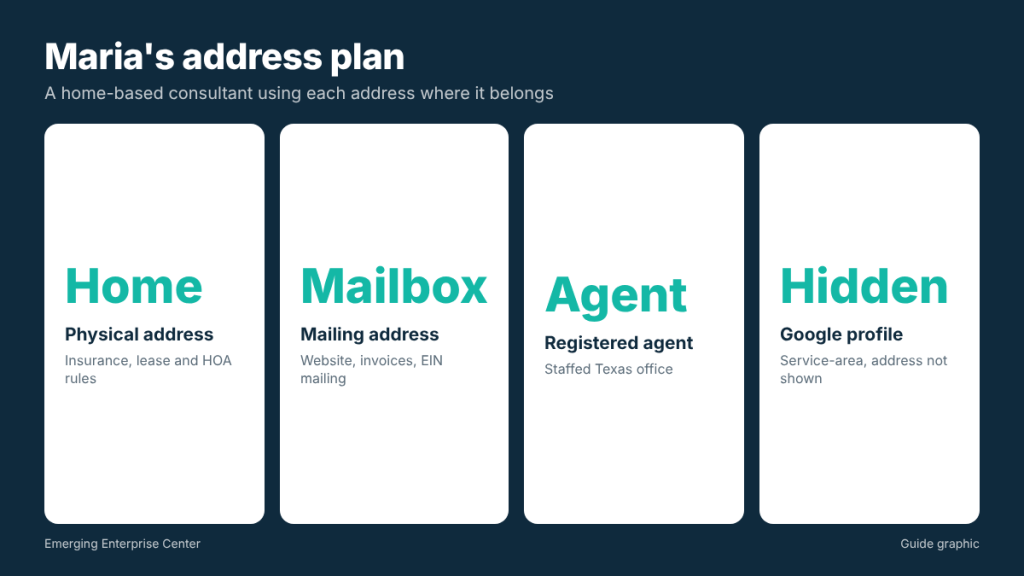
Maria runs a one-person marketing consultancy from her apartment. She forms a Texas LLC and wants her home address off public records. Here is how her address plan looks:
- Physical address: her apartment. Used for her lease review, renter’s or business insurance, and any city or HOA rules about home businesses. It does not appear on her website.
- Mailing address: a private mailbox with a street address and suite number. Used on her website, invoices, contracts, business cards, the EIN application mailing field and vendor accounts.
- Registered agent: a commercial registered agent service with a staffed Texas office, so legal papers are accepted during business hours even when she is with clients.
- Google Business Profile: set up as a service-area business with the address hidden, since she meets clients at their offices.
The result: three addresses, each used where it belongs. Her apartment number appears only on forms that truly require her operating location, and her mail lands somewhere secure that accepts packages from every carrier.
Common mistakes and how to avoid them
- Using a PO Box as a physical address. Most state filings, banks and insurers will reject it. If a form asks for a street address, a PO Box is the wrong answer.
- Listing a mailbox as your registered office. A mailbox cannot accept service of process the way a staffed registered agent can. This can lead to missed lawsuits and default judgments.
- Mixing formats. Writing “Suite 120” on one account and “#120” or “PMB 120” on another creates mismatches during verification. Pick the format your mail provider recommends and use it everywhere.
- Forgetting to update the mailing address after a move. Notices from the IRS, the state and your bank keep going to the old address, and some of them carry deadlines.
- Hiding the physical address from your insurer. Coverage questions start with where the loss happened. Be accurate with anyone pricing risk.
Your address planning checklist
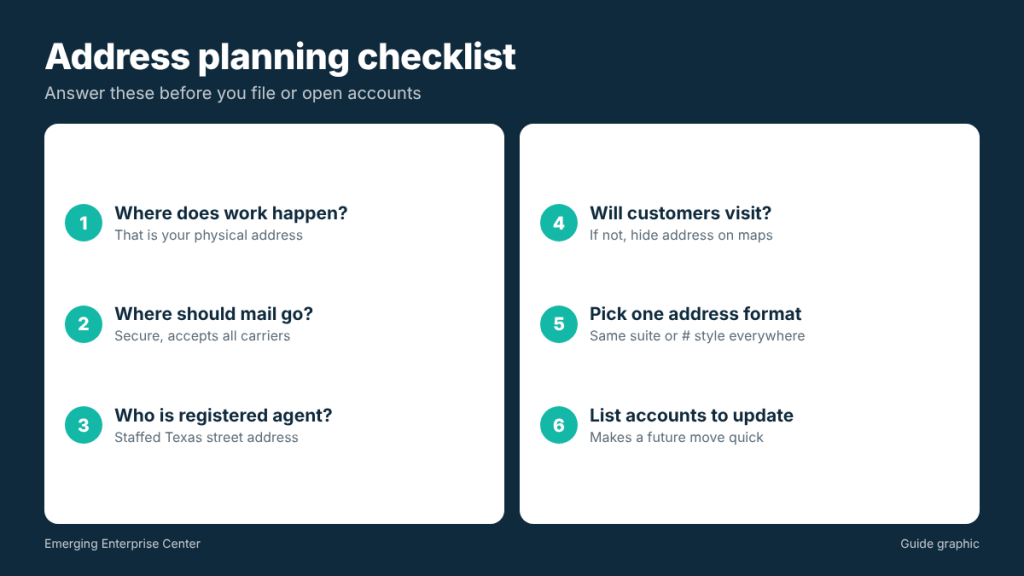
Before you file formation documents or open accounts, write down answers to these questions:
- Where does the work actually happen? That is your physical address.
- Where should mail and packages go? Choose a place that is secure and accepts the carriers your vendors use.
- Who will be your registered agent, and at what staffed Texas address?
- Will customers visit you? If not, plan to hide your address on map listings.
- What exact format will you use for the mailing address, including the suite or box number?
- Which accounts need updating if any of these change? Keep a list so a future move takes an afternoon, not a month.
Keep this sheet with your formation records. It becomes the reference anyone helping you, from a bookkeeper to a new partner, can follow to keep addresses consistent.
Frequently asked questions
Can my mailing address and physical address be the same?
Yes. If you operate from a storefront or office that receives mail, use it for both. Separate addresses are useful when you work from home or travel, not mandatory.
Is a private mailbox a physical address?
It is a real street address where mail is received, but it is not where your business operates. Use it as your mailing address and answer “where do you operate” questions with your actual location.
Do I have to publish my physical address on my website?
Generally no. Most small businesses can show a mailing address on their site. Some regulated industries and platforms have their own disclosure rules, so check if yours does.
What happens if my registered agent address is wrong?
Legal papers might not reach you, and you could miss deadlines in a lawsuit. Keep the registered agent information current with the Secretary of State and update it promptly if it changes.
This article is general information, not legal advice. For questions about your specific filings, check the agency’s instructions or speak with a qualified professional.
Need a mailing address that is not your home?
Houston business owners in the Galleria and Uptown area can use The Postal Spot’s private mailbox rental for a real street address, package receiving from all carriers and on-site help with Form 1583.