A buyer is ready to close on your Houston condo, your bank needs a notarized form to change signers on the business account, or a court in Texas wants a sworn statement from you. The problem is that you are in Tokyo, Lagos or Buenos Aires, and the document says “notary public” on it. Learning how to sign US documents while abroad is mostly about choosing the right method for the document and the person receiving it, then leaving enough time for the paperwork to travel.
This guide compares the main options: electronic signatures, remote online notarization, US embassy and consulate notarial services, local foreign notaries with an apostille, and a power of attorney signed before you leave or from overseas. For each, you will see when it works, what it involves, and the questions to ask first. Acceptance rules vary by state, agency and institution, and legal documents can have serious consequences, so confirm the requirements with the receiving party and consider an attorney. This is general information, not legal advice.
Step one: ask the receiving party exactly what they will accept
Before you pick a method, contact whoever will receive the document (the title company, bank, court clerk, agency or attorney) and ask:
- Does this document need to be notarized, or is an electronic signature enough?
- Will you accept remote online notarization?
- Will you accept a notarization from a US embassy or consulate?
- Will you accept a foreign notarization, and if so, does it need an apostille?
- Do you need the original paper, or will a scan or electronic copy do?
- What is your deadline, and where should the original be sent?
Write down the answers. They will determine every step that follows and prevent you from completing the wrong process.
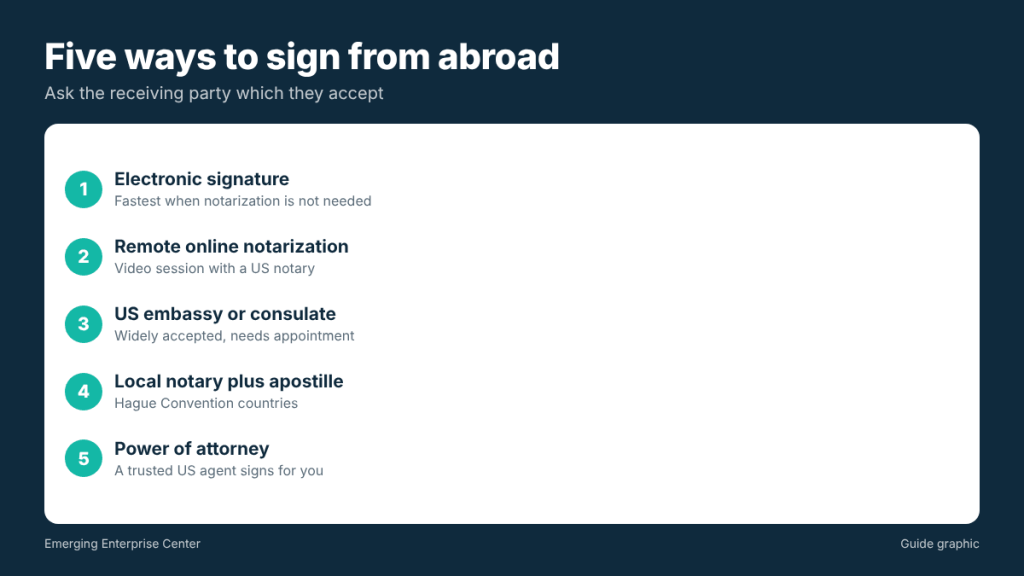
How to sign US documents while abroad: the five main options
1. Electronic signature
Many contracts, agreements, bank forms and business documents can be signed electronically with a standard e-signature platform. If the receiving party accepts it, this is the fastest and cheapest option. It does not work for documents that specifically require notarization unless the process includes an electronic notarization.
2. Remote online notarization (RON)
Several US states, including Texas, allow commissioned online notaries to notarize documents over a secure audio-video session. You verify your identity through the platform’s process, sign electronically and receive an electronically notarized document. Some platforms and state rules allow signers located outside the US, often with conditions, for example that the document relates to a matter in the US. This can be the quickest notarized option, but confirm the receiving party accepts it, especially for real estate and court filings.
3. US embassy or consulate
Many US embassies and consulates offer notarial services for documents to be used in the US. You generally need an appointment, your passport and the unsigned document. Appointment availability varies widely by location, and a fee applies (check the embassy’s website for the current amount). Consular notarizations are widely accepted in the US because they are performed by US officials.
4. Local foreign notary plus an apostille
If the country you are in is part of the Hague Apostille Convention, you can often have the document notarized by a local notary and then obtain an apostille from the designated authority in that country. The apostille certifies the notary’s authority so the document can be recognized in the US. In countries that are not part of the convention, a longer authentication process may apply. Confirm the receiving party accepts a foreign notarization before you go this route.
5. Power of attorney
A power of attorney lets a trusted person in the US sign specific documents for you. It is especially useful for real estate, banking and recurring business tasks. The power of attorney itself usually needs to be notarized, so many people sign it before they leave the US. If you are already abroad, you can sign it using one of the methods above. Some institutions have their own power of attorney forms or requirements, so check first.
Comparing the options
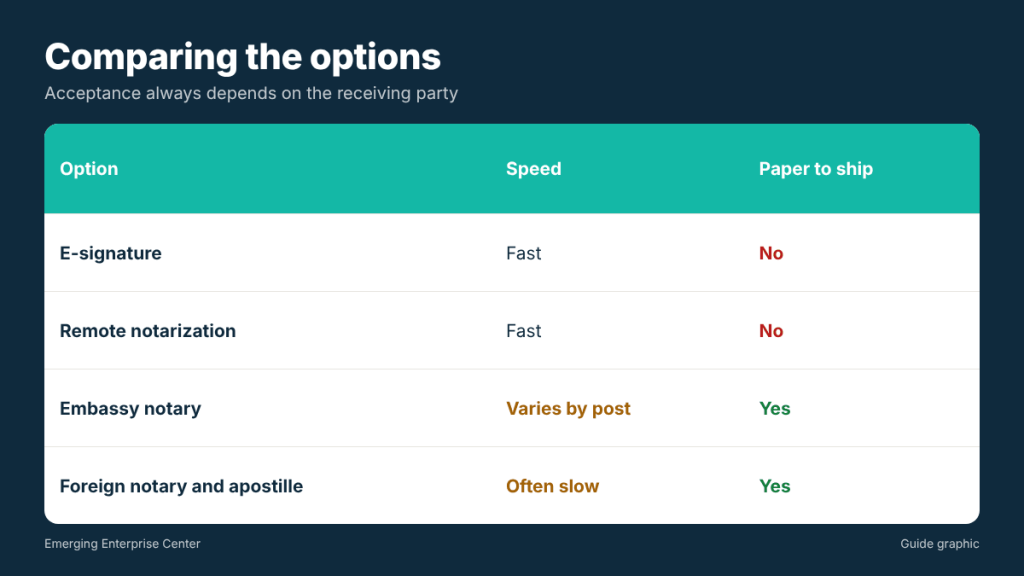
- Speed: electronic signatures and RON are typically the fastest. Embassy appointments and apostilles can take longer.
- Cost: e-signatures are often free or inexpensive. RON, embassy services and apostilles each have fees, plus courier costs for paper originals.
- Acceptance: embassy notarizations are broadly accepted. RON and foreign notarizations depend on the receiving party.
- Paper originals: embassy and foreign notary routes produce paper documents that must be shipped back to the US. RON produces an electronic original.
A planning example with a real deadline
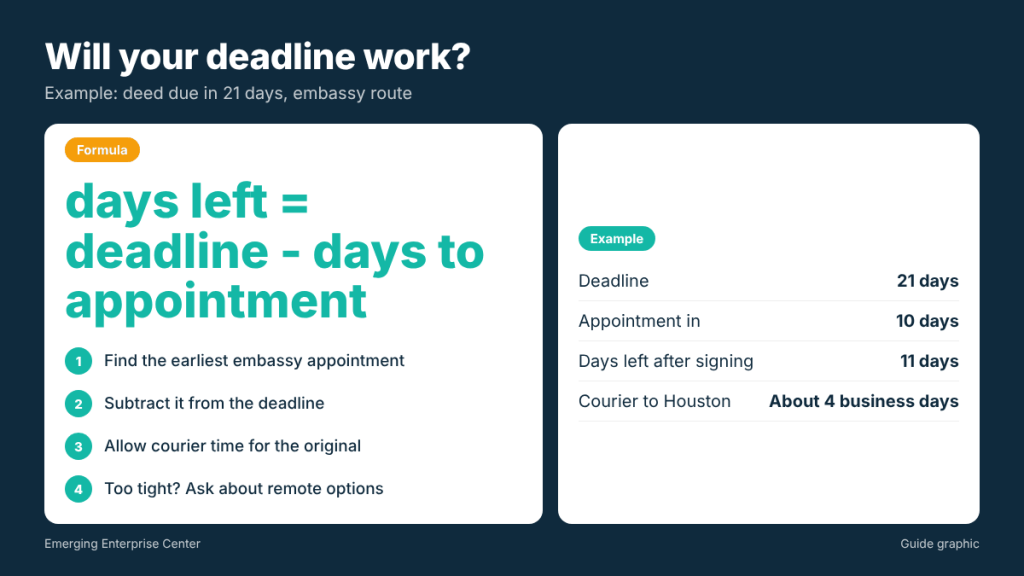
Suppose a title company needs your notarized signature on a deed in 21 days, and it accepts embassy notarizations but not foreign notaries. If the next embassy appointment is 10 days away, you have 11 days left after signing (21 minus 10). If international courier delivery to Houston takes about 4 business days, you would still have roughly a week of cushion. If the embassy’s earliest appointment is 18 days away, though, you would have only 3 days left, which is too tight for international shipping. In that case, ask the title company whether RON is acceptable, or whether a power of attorney for a local representative would work.
Logistics for paper originals
- Print the document correctly. US documents are formatted for US letter paper. Printing on A4 may cut off text or the notary certificate. Ask the sender for a PDF and adjust the print settings to fit.
- Do not sign in advance. Bring the document unsigned to the notary or embassy, along with your passport.
- Use a tracked courier to send originals back to the US, and keep the tracking number.
- Scan everything before you send it, including the notary certificate and any apostille.
- Send to the right address. Confirm whether originals go to the title company, attorney, bank or your own US mailing address for later handling.
Common mistakes that cause rejections
- Using the wrong certificate wording. A foreign notary may attach their own country’s certificate. Some US recipients require specific US wording, so bring the document with its certificate already printed.
- Missing pages after printing. Check that every page printed, including exhibits.
- Name differences. The name on your passport should match the name on the document.
- Skipping the apostille. A foreign notarization without the required apostille is often rejected outright.
Plan ahead before your next trip
If you live abroad or travel often, a little preparation saves a lot of stress:
- Sign a power of attorney for key matters while you are in the US.
- Keep a US mailing address with scanning, so you see documents as soon as they arrive.
- Find out in advance which of your banks and agencies accept RON or electronic signatures.
- Note the location and appointment process for the nearest US embassy or consulate.
- Keep your passport valid with plenty of time remaining, since it is the ID you will rely on.
Frequently asked questions
Can a foreign notary notarize a US document?
A foreign notary can often notarize your signature, but whether a US recipient will accept it varies. An apostille may be needed. Confirm with the receiving party first.
Is a consular notarization the same as a US notarization?
Consular officers are authorized to perform notarial acts for documents to be used in the US, and their notarizations are widely accepted.
Can I use remote online notarization from another country?
Often, yes, depending on the platform and the notary’s state rules. Confirm that the receiving party accepts it for your type of document.
What if my document needs a witness as well as a notary?
Arrange witnesses who meet the receiving party’s requirements. Embassies may not supply witnesses, so ask in advance.
Signing before you fly out of Houston?
Get your power of attorney or other documents notarized before you leave at The Postal Spot’s walk-in notary in Houston, with no appointment required.