
If you have decided your Texas business needs more than a sole proprietorship, the next question is usually LLC or corporation. Both create a separate legal entity, both can protect your personal assets when they are set up and run properly, and both are formed by filing a certificate of formation with the Texas Secretary of State. The differences show up in how you manage the business, how it is taxed, how you bring in investors and how much formal paperwork you keep each year.
This guide compares a Texas LLC and a Texas corporation side by side, walks through who each structure tends to fit, and gives you a short decision checklist to take to your accountant or attorney. It focuses on practical differences, not theory, so you can make a confident choice before you file.
What they have in common
Start with the similarities, because they are significant:
- Same filing office. Both are formed with the Texas Secretary of State under the Texas Business Organizations Code.
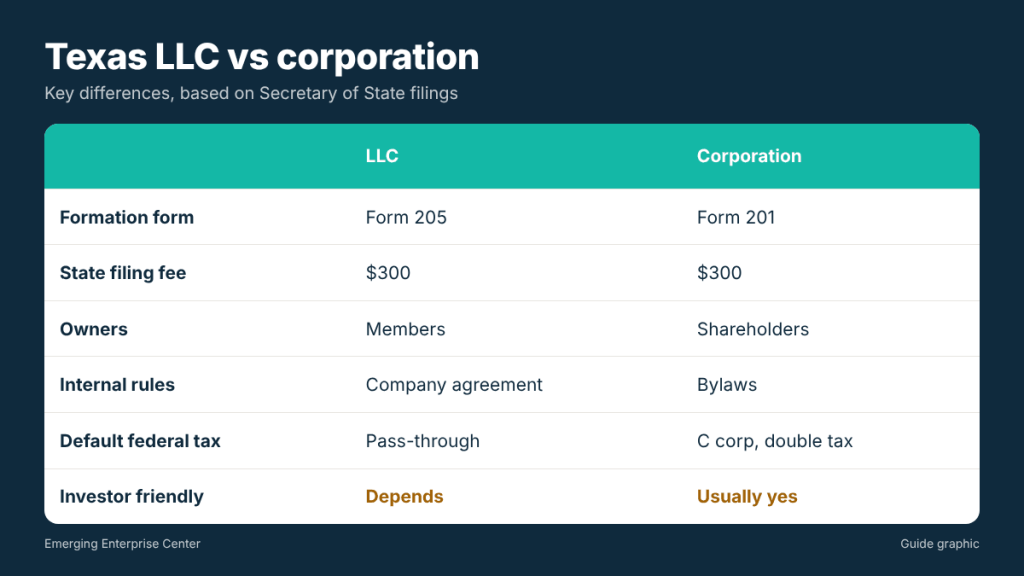
- Same state filing fee. The Secretary of State lists a $300 filing fee for a certificate of formation for an LLC (Form 205) and $300 for a for-profit corporation (Form 201). Check the Secretary of State’s website for current fees before filing.
- Registered agent required. Each must name a registered agent with a physical Texas address staffed during business hours.
- Liability protection. Owners are generally not personally liable for the entity’s debts, as long as the business is kept separate and run properly.
- Texas franchise tax. Both LLCs and corporations are generally subject to the Texas franchise tax and its annual reporting through the Texas Comptroller.
Because the filing cost and state tax treatment are so similar, the decision usually comes down to management, federal taxes and future plans.
How each is owned and managed
LLC
Owners of an LLC are called members. An LLC can be member-managed, where the owners run the business directly, or manager-managed, where designated managers run it. The internal rules live in a company agreement (often called an operating agreement in other states). Texas gives LLCs a lot of flexibility to set ownership percentages, voting rules and profit splits in that agreement.
Corporation
A corporation is owned by shareholders, overseen by a board of directors and run day to day by officers such as a president and secretary. In a small corporation, one person may hold all of these roles. The rules live in bylaws, and ownership is represented by shares of stock. Corporations follow a more defined governance structure: board meetings, shareholder meetings, written consents and minutes.
For a solo founder or a few partners who want to run things informally, the LLC’s flexibility is usually appealing. For a company that expects outside investors, the corporation’s familiar structure can be an advantage.
How each is taxed at the federal level
This is where the two diverge the most, and where professional advice matters most.
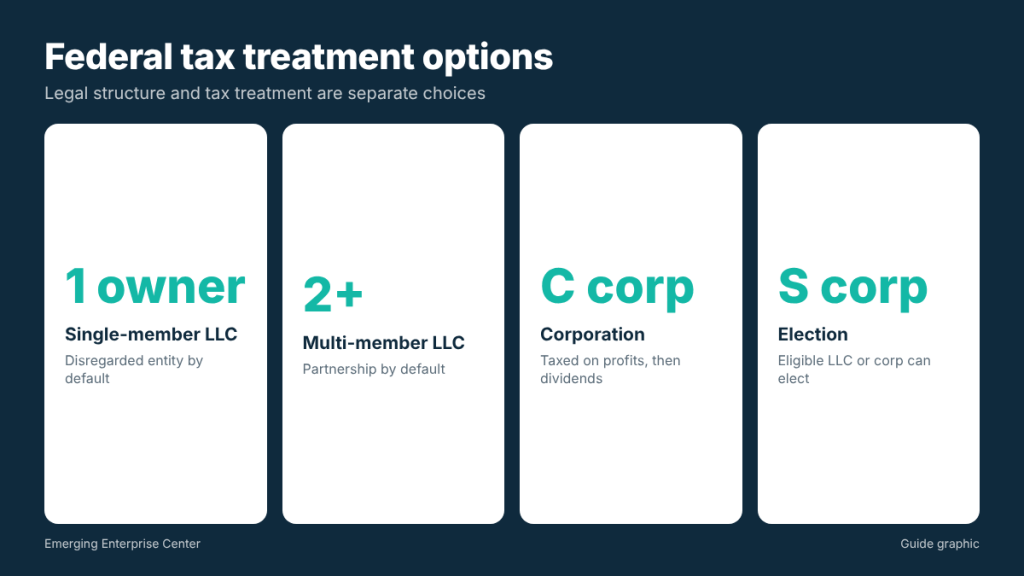
- LLC by default: a single-member LLC is treated as a disregarded entity, and a multi-member LLC as a partnership. Profits pass through to the owners’ personal returns.
- Corporation by default: a C corporation pays tax on its own profits, and shareholders pay tax again on dividends they receive. This is often called double taxation.
- S corporation election: an eligible LLC or corporation can elect S corporation tax treatment, which passes income through to owners while allowing some payroll planning. Eligibility rules limit who can be a shareholder.
- LLC electing corporate tax: an LLC can also elect to be taxed as a C corporation if that suits its plans.
In practice, your legal structure and your tax treatment are two separate choices. Many small businesses form an LLC for its simplicity and then choose the tax treatment that fits once profits grow.
Raising money and adding owners
- Corporations issue shares, can create different classes of stock and are the structure many venture investors expect. Stock options for employees are also more straightforward in a corporation.
- LLCs issue membership interests. Adding members is entirely possible, but it usually means amending the company agreement, and some investors prefer not to invest in pass-through entities.
If you are building a company you hope to fund with outside investors, discuss the structure with an attorney before filing. Converting later is possible, but it adds cost and paperwork.
Paperwork and ongoing formalities
Both structures need records, but the expectations differ:
- LLC: keep your certificate of formation, company agreement, member records, tax filings and important decisions in writing. Texas does not require annual member meetings for LLCs by default, though your company agreement can.
- Corporation: keep bylaws, a stock ledger, board and shareholder minutes or written consents, and officer appointments. Following these formalities helps show the corporation is truly separate from its owners.
- Both: file the Texas franchise tax report and related information report each year, keep your registered agent current, and file amendments when key details change.
Worked example: two Houston founders
Ana runs a bookkeeping practice on her own and plans to stay small. She wants liability protection, simple management and pass-through taxes. An LLC fits: she files Form 205, pays the $300 state fee, signs a simple single-member company agreement and keeps her records in a folder.
Dev and two co-founders are building a software product and plan to raise money from investors within a year. Their attorney recommends a corporation so they can issue shares and set up an employee option pool. They file Form 201, also with a $300 state fee, adopt bylaws, appoint officers and record founder share issuances. Same filing fee, very different paperwork.
What to prepare before you file either one
Whichever structure you pick, the filing goes faster with these details ready:
- Your exact entity name, confirmed as available, with the right ending such as “LLC” or “Inc.”
- Your registered agent’s name and Texas street address, plus their consent to serve.
- Management details: for an LLC, whether it is member-managed or manager-managed and the names involved; for a corporation, the initial directors.
- The organizer or incorporator who signs the filing.
- A mailing address you check reliably for state, IRS and bank correspondence.
- A plan for your internal document, either a company agreement or bylaws, ready to sign soon after approval.
A decision checklist
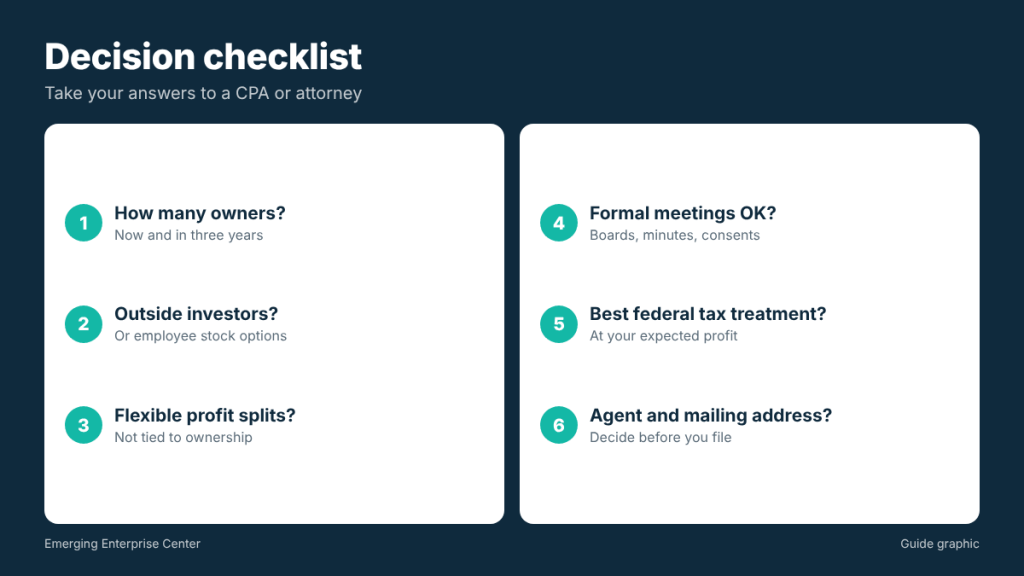
Answer these questions before you file, and take your answers to a CPA or attorney:
- How many owners will there be now, and in three years?
- Will you seek outside investors or offer stock options?
- Do you want flexible profit splits that do not match ownership percentages?
- How comfortable are you with board meetings, minutes and formal consents?
- What federal tax treatment makes sense at your expected profit level?
- Who will be your registered agent, and what mailing address will the business use?
If most answers point to “few owners, no investors, keep it simple,” an LLC is the usual choice. If they point to “investors, shares and growth,” a corporation deserves a serious look.
Frequently asked questions
Is an LLC cheaper to form than a corporation in Texas?
Not at the state level. The Secretary of State lists $300 for both a certificate of formation for an LLC and for a for-profit corporation. Professional fees and ongoing costs may differ.
Can I change from an LLC to a corporation later?
Yes, Texas allows entity conversions, but it involves filings and possibly tax consequences. Plan with a professional before converting.
Does a corporation give better liability protection than an LLC?
Both can provide strong protection when properly maintained. Mixing personal and business finances or ignoring formalities can weaken either.
Can my LLC or corporation use a private mailbox address?
It can generally use one as its mailing address. The registered office must be a physical Texas address where the agent is available during business hours.
This article is general information, not legal or tax advice. Fees and rules can change; confirm current requirements with the Texas Secretary of State and a qualified professional.
Forming a new entity in Houston?
Give your LLC or corporation a professional mailing address with The Postal Spot’s business mailbox rental, including package receiving from all carriers.