
Few errands are as frustrating as driving to a notary, waiting your turn, and being told you cannot finish because something is missing. It happens constantly: an expired license, a signer who stayed home, a page left on the printer. If you are asking what do I need to bring to a notary, the answer is a short list, but every item on it matters, and missing just one usually means a second trip.
This guide gives you a complete checklist for a typical walk-in notarization, explains why each item is required, covers the extra items for common business documents, and lists the mistakes that most often send people home empty-handed. Notary rules are set by each state, and this article reflects general practice, so check your document’s instructions and ask the notary if anything is unclear. It is general information, not legal advice.
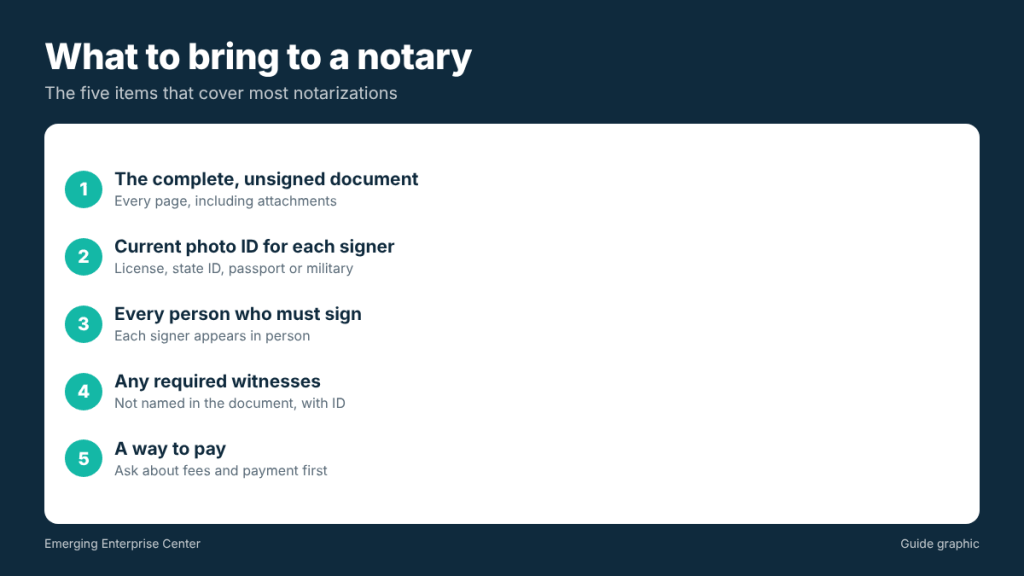
What do I need to bring to a notary? The core checklist
For most notarizations, you need these five things:
- The complete, unsigned document. Every page, including attachments and exhibits. Do not sign it before you arrive unless the notary has told you that is fine for your document type.
- Current government-issued photo ID for every signer. A driver’s license, state ID card, passport or military ID is typical. It must be unexpired.
- Every person who needs to sign. Each signer must appear in person before the notary. A spouse or business partner cannot sign on someone’s behalf.
- Any required witnesses. Some documents need one or more witnesses in addition to the notary. Check the document’s signature block.
- A way to pay. Ask about the fee and accepted payment methods before you go.
If you bring those five items, most routine notarizations take only a few minutes.
Why each item matters
The full document
A notary needs to see the document to identify the type of notarial act required and to complete the certificate correctly. Bringing only the signature page is a common error. Many notaries will decline to notarize a loose signature page because they cannot confirm what it belongs to.
Valid identification
The notary’s core job is confirming that you are who you say you are. Your ID must be current and should include your photo and signature. The name on the ID should match the name on the document. Small differences (a middle initial versus a full middle name) are often acceptable, but a different last name after marriage can be a problem if your ID has not been updated.
Physical presence
Traditional notarization requires each signer to stand in front of the notary. If one signer is out of town, they will need to visit a notary where they are, or use a remote online notarization service if their state and the receiving party allow it.
Witnesses
Notaries are not usually allowed to act as witnesses to the same document they notarize, and many offices do not supply witnesses. If your document calls for witnesses, bring people who are not named in the document and who have their own ID.
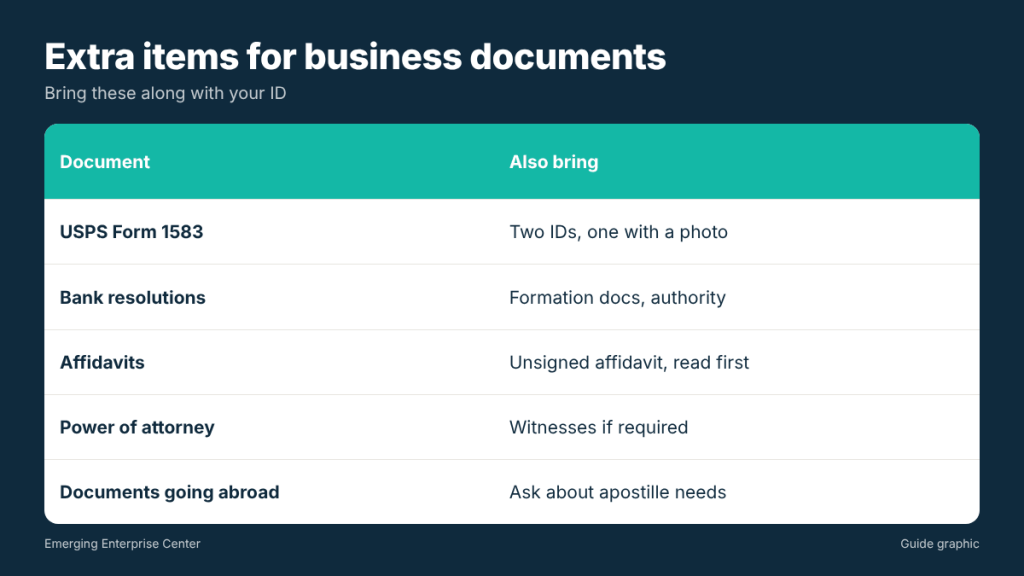
Extra items for common business documents
Business paperwork often comes with additional requirements. Here is what to bring for documents small business owners notarize most often:
- USPS Form 1583 (private mailbox application): two forms of ID, one with a photo, plus a document showing your current address if the mail store asks. Bring business formation documents if the box is in an LLC’s name.
- Bank resolutions or account forms: your LLC’s certificate of formation and any document showing your authority to sign, such as an operating agreement or resolution.
- Affidavits: the unsigned affidavit and your ID. You will swear or affirm that the contents are true, so read it carefully before your appointment.
- Powers of attorney: the full document, ID for the person granting the power, and witnesses if your state’s form requires them.
- Vehicle title transfers and related forms: the title or form, ID, and any lienholder release if applicable.
- Documents going overseas: ask the receiving country or agency whether they will also need an apostille or authentication after notarization, so you can plan the next step.
Know which type of notarization you need
Most documents call for one of two common notarial acts, and knowing which one yours needs helps you arrive prepared. The wording on the notary certificate usually tells you.
- Acknowledgment. You confirm to the notary that you signed the document willingly. Certificates often begin with phrases like “acknowledged before me.” Deeds, powers of attorney and many business agreements use this form.
- Jurat. You swear or affirm that the contents of the document are true, and you sign in front of the notary. Certificates often include “sworn to and subscribed before me.” Affidavits and many sworn statements use this form.
If the document has no notary certificate at all, the notary cannot choose one for you, because that would be deciding a legal question on your behalf. Ask the person or agency that requested the document which certificate they need, and bring their answer with you.
Signing for a business
When you sign on behalf of an LLC or corporation, the notary still identifies you personally with your own ID. Your title (for example, “Managing Member”) goes next to your signature as the document instructs. The notary is not verifying your authority to sign for the company, so bring proof of authority only if the receiving party asks for it.
Mistakes that cause a second trip
These are the problems notaries see most often:
- Expired ID. An ID that expired last week is still expired. Check the date before you leave.
- Signed in advance. If the document requires an acknowledgment, the notary may need to see you sign, or you may need to sign again. For a jurat (sworn statement), you generally must sign in front of the notary.
- Blank spaces. Notaries may refuse to notarize a document with blank fields that should be filled in. Complete everything, or write “N/A” where a field does not apply.
- Missing pages. Print the whole document and keep the pages in order.
- Name mismatch. Make sure the name printed on the document matches your ID.
- Asking for advice. A notary who is not an attorney cannot tell you which form to use or how to fill it out. Get those answers from the person who requested the document.
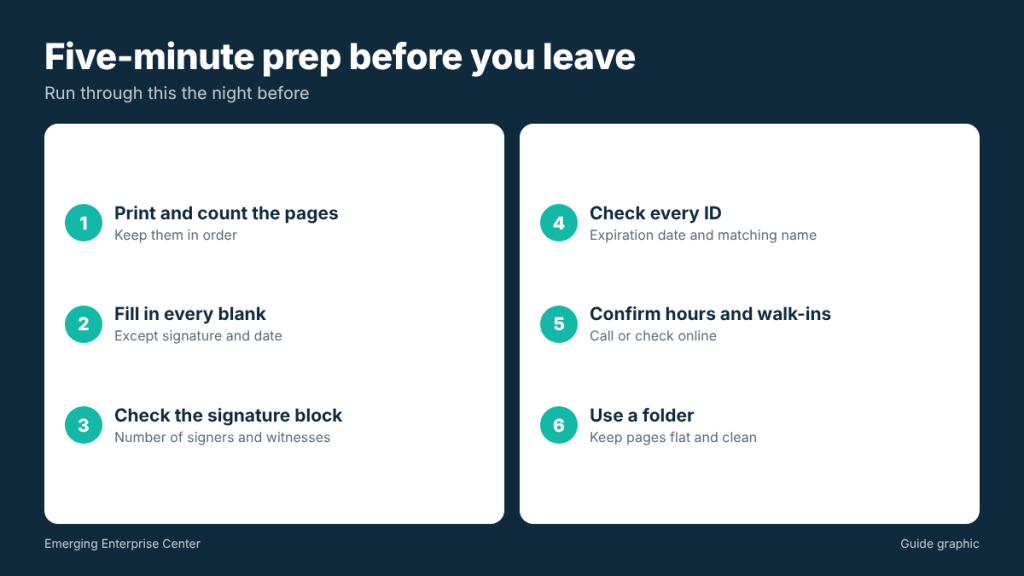
A five-minute prep routine before you leave
Run through this quick routine the night before or just before you head out:
- Print the full document and count the pages.
- Read it once and fill in every blank except the signature and date lines.
- Check the signature block for the number of signers and whether witnesses are required.
- Check each signer’s ID expiration date and confirm the names match the document.
- Call or check the notary’s hours and whether walk-ins are accepted.
- Put the document in a folder so the pages stay flat and clean.
Walk-in notary counters are convenient for business owners because you can combine the visit with other errands, such as shipping the notarized document right away or opening a mailbox that requires a notarized Form 1583.
Frequently asked questions
Can I bring a photo of my ID on my phone?
Generally, no. Notaries need to examine the physical ID. Bring the actual card or passport.
What if I do not have a valid photo ID?
Some states allow identification through credible witnesses who know you and have their own valid ID. Rules vary, so ask the notary in advance what they can accept.
Does the notary need to read my document?
The notary looks at the document to complete the correct certificate and check for blanks, but does not review it for legal accuracy or tell you what it means.
Do I need an appointment?
Many mail and shipping stores offer walk-in notary service. For large signings with several people, calling ahead is still a good idea.
Ready to get your document notarized?
Bring your checklist to The Postal Spot’s walk-in notary service in Houston, with no appointment needed.