Running a business without an office is normal now. Consultants, accountants, designers, coaches and agency founders work from home, coworking spaces and laptops on the go. The question comes up the moment a client says, “Let’s meet in person.” Inviting them to your home feels unprofessional and unsafe. A noisy coffee shop is fine for a casual chat, but not for reviewing a confidential contract. And booking a room every time feels like a hassle.
This guide lays out the realistic places to meet clients when you do not have an office, how to match the venue to the type of meeting, what to check before you book, and how to keep your home address private while still looking established. It finishes with a simple system so you are never scrambling for a location the day before.
What makes a good client meeting location
Before comparing options, decide what the meeting needs. Most client meetings depend on a handful of factors:
- Privacy: will you discuss finances, legal issues, health or other confidential topics?
- Noise: can you hear each other, and can you take a video call participant on speaker?
- Tools: do you need a screen, whiteboard, power outlets or reliable Wi-Fi?
- Access: is parking easy, is it accessible for everyone attending, and is it simple to find?
- Length: a 20-minute check-in and a three-hour workshop need different spaces.
- Impression: is this a first meeting with a new prospect, or a routine check-in with a long-time client?
Your main options, compared
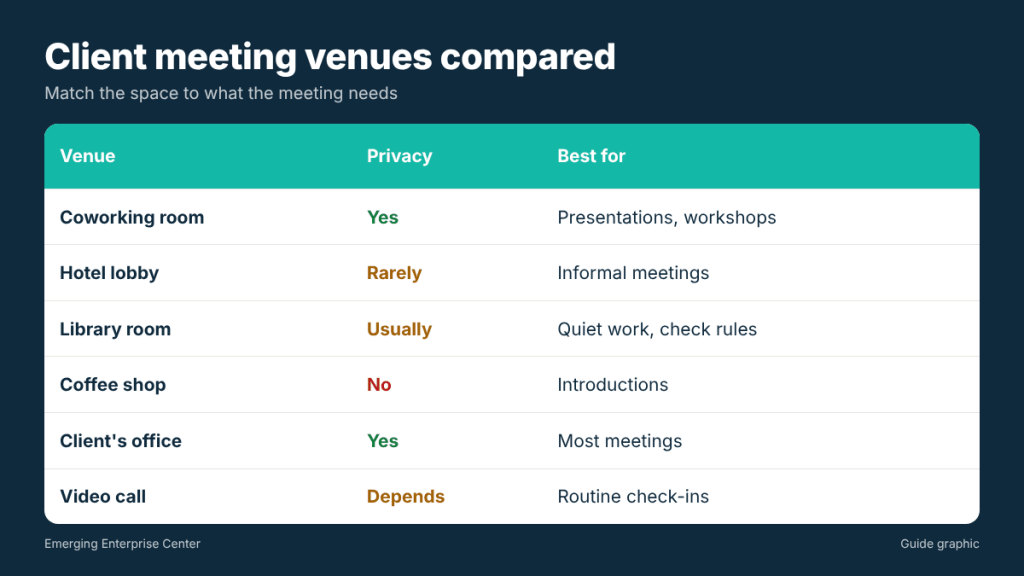
Coworking meeting rooms and day passes
Coworking spaces rent conference rooms by the hour or include a set number of room hours with membership. You get privacy, a screen, whiteboards and a professional setting. Many also offer reception that greets guests. Book ahead during busy weeks.
Hotel lobbies and business centers
Hotel lobbies are usually quiet in mid-morning and mid-afternoon, with comfortable seating and easy parking. Some hotels offer small meeting rooms or business centers for rent. They are good for informal meetings but not private enough for sensitive conversations in the open lobby.
Public library study or meeting rooms
Many public libraries offer reservable rooms. They are quiet and free or low cost in many cases, but rules vary, and some prohibit commercial activity or sales presentations. Check the library’s policy before booking.
Coffee shops and restaurants
Ideal for introductions, networking and relationship-building. Poor for confidential work or anything that requires spreading papers out. A restaurant with a private room or a quiet booth can work for a lunch meeting with an important client.
The client’s office
Often the best choice. The client is comfortable, has their own tools and team nearby, and you avoid booking anything. Offer it first when the client has a suitable space. Ask ahead about visitor check-in, parking validation and whether you can connect to their screen.
Private dining rooms and professional association spaces
For a meeting that mixes business and relationship building, a restaurant private dining room gives you privacy with a meal. Professional associations, chambers of commerce and alumni clubs sometimes offer members access to meeting rooms or lounges. If you already belong to one, ask what is available. These spaces carry a polished feel without a long-term commitment.
Video calls
For many routine meetings, video is faster for everyone. Save in-person meetings for kickoffs, workshops, signings and relationship moments where being in the room matters.
Match the venue to the meeting type
- First coffee with a prospect: coffee shop or hotel lobby.
- Proposal presentation: coworking meeting room with a screen, or the client’s office.
- Confidential review (finances, legal, HR): private room only, either a booked meeting room or the client’s office.
- Working session or workshop: a meeting room with whiteboards and enough time on the booking.
- Document signing: a private, quiet room, or meet at a notary location if the documents require notarization.
- Routine check-in: video call.
Worked example: a consultant’s typical month
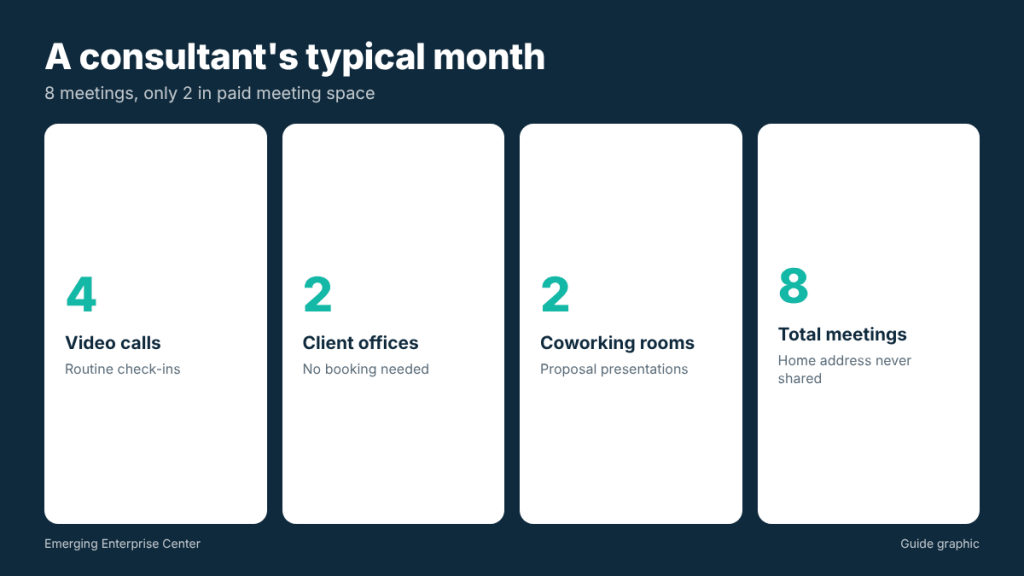
A Houston consultant averages 8 client meetings a month. She handles 4 as video calls, holds 2 at clients’ offices and books a coworking room for the other 2, both proposal presentations with new prospects. That means she pays for meeting space only twice a month (8 minus 4 minus 2 equals 2), while every meeting still happens in a setting that fits its purpose. Her home address never comes up.
Keeping your home address private
Meeting outside your home is half the battle. The other half is making sure your home address does not appear in the materials clients see:
- Use a business mailing address on proposals, invoices, email signatures and your website. A private mailbox with a street address and suite number looks established and accepts mail and packages from any carrier.
- Put the meeting location in the calendar invite, not your business address, so clients do not drive to your mailbox.
- Set up your online listing carefully. Google Business Profile does not allow a PO Box or virtual office as a verified location. If clients do not visit you, consider a service-area profile with the address hidden.
- Keep client documents separate. Have contracts and checks sent to your business mailing address rather than handed over at home.
Before-the-meeting checklist
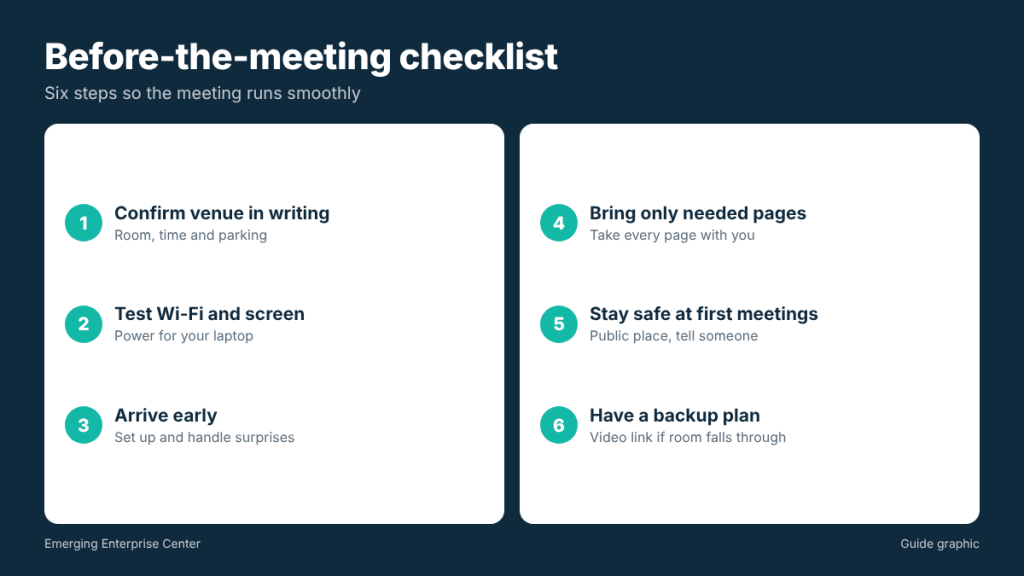
- Confirm the venue, room and time in writing, with parking instructions.
- Check the Wi-Fi, screen connection and power for your laptop if you are presenting.
- Arrive early enough to set up and handle surprises.
- Bring printed copies only if needed, and take every page with you when you leave.
- For first meetings with someone new, choose a public or staffed location and tell someone where you will be.
- Have a backup plan, such as a video link, in case the room falls through.
Handling documents and payments at meetings
Meetings away from an office mean you carry the paperwork. A few habits protect both you and your client:
- Bring only what the meeting needs. Leave unrelated client files at home or in secure cloud storage.
- Use a folder or portfolio, not loose pages, and check the table before you leave.
- Prefer e-signatures for routine contracts so you are not carrying signed originals around town.
- Do not collect sensitive forms in public spaces. Ask clients to send documents with account numbers or Social Security numbers to your business mailing address or through a secure upload.
- Accept payments electronically when possible. If a client hands you a check, store it securely and deposit it promptly.
- Dispose of notes carefully. Meeting notes with client details belong in your files or a shredder, not a coffee shop trash can.
Build a simple meeting system
Instead of deciding each time, set up a short list:
- Two coffee shops you know are quiet at certain hours.
- One coworking space where you can book a meeting room by the hour.
- One hotel lobby near major roads for easy access.
- Your standard video link saved in your scheduling tool.
- A nearby notary option for signings that require one.
Save these with addresses and parking notes in a document or your scheduling tool, so booking a meeting takes a minute. Review the list every few months, since coffee shops change hours, coworking spaces change pricing and new options open up. When a client suggests a place that works well, add it.
Frequently asked questions
Is it unprofessional to meet clients at a coffee shop?
Not for introductions and casual conversations. For confidential topics or presentations, a private room is more appropriate.
Can I use a coworking space address as my business address?
Some coworking plans allow it, others limit address use. Check the membership terms, or use a separate private mailbox for mail.
Should I ever meet clients at home?
It is your choice, but many owners avoid it for safety, privacy and liability reasons, and some leases or deed restrictions limit client visits.
What is the best place to sign documents with a client?
A quiet private room. If the documents need a notary, meet at a notary location so everyone signs in one visit.
Want a professional address without an office?
Private mailbox rental in Houston gives you a real street address for proposals and invoices while you meet clients wherever works best.